poetry

The Love of Nadia Chance


It begins again. The voices of the women singing in the background as the morphine kicks in. I can feel the first wave now. The Troll is in the kitchen with Ron de Veux and there is a knock at the door of his subterranean apartment.

The evening has been particularly disturbing. I have been nursing the last few milligrams of the drug and have not been able to drown out the piercing cries of the tenants above me. In between the cries I hear the frantic fluttering of wings. Angels. The other junkies believe the Troll when he says they are angels. I’m not quite sure but the fluttering of the wings always gets to me. I can hear those wings even in the deepest junk nod.

I answer the door and it is Nadia Chance. She kisses me on the lips, her breath is musky and heavy reeking of promises kept and hearts broken. She holds up her hand and there is a vial in it.

Samuel, the pharmacist who is totally taken by her, is her supplier of morphine. The price of hot whispers and a burning mouth that makes him wake shuddering in the night is one-hundred tablets of 15mg morphine, three times a week. One day it will cost him his license and his frigid wife. Then Nadia’s mouth will cool, his store will close and his wife will sue him for what is left. Instead of sucking on Nadia’s open places he will place his double-shot .38 into his mouth and spray the bathroom wall with blood and brains. But this is yet to come.

One night, during yen sleep, before Nadia had even met Samuel, the Troll had one of his dreams. When he awoke he asked Nadia to go to the pharmacy on the corner of 88th Street and Broadway. She had asked why she was to do this and the Troll just smiled and said

“Hurry. Just go.”

And she did. Four hours later she returned with pinned eyes and a bottle of morphine tablets, enough to fix every junkie in the apartment. After we had all fixed the Troll spun the tale of Samuel and Nadia. At the close of the story, when Samuel lay dead in the blood spattered bathroom, the Troll admitted that it was only a dream.

After hearing the tale Nadia went out walking the streets of the city and did not return until the sun was rising. She immediately swallowed three tabs and shot two of them. Then she made coffee and stared at the basement window for a few hours. All the basement windows are curtained and beneath the curtains the glass has been painted black.

She has been seeing Samuel regularly for seven months.

My hand shakes with sickness as I try to fix and Nadia reaches over and gently takes the hypodermic from my hand. I hold the belt tight around my arm and she places the needle directly over the scab from my last shot and taps it in. Blood spot at the bottom. She nudges the plunger back and my red life flows into the barrel. Slowly she slips the plunger to the bottom of the syringe and I disappear into myself.

I look up at her as she kisses my forehead.

There is a knock at the door.

I function as the gatekeeper and open the door. Sunken eyes are the first thing I see, dark with night that seeps into my own and I feel the tears rush to the back of my eyewall. He has a forehead with cavernous furrows yet his cheeks are smooth and appear to have no hair at all on them. His lips are soft and inviting and look ever-so-kissed. Above his lip, just below his nose, the normal ridges of the upper lip are absent, just a smooth track from one side of his mouth to the other.

I recall a tale that my mother told me. It was an old fable about the child in the womb. She said that we, as unborn, contain all the knowledge of our past and future lives within us as we rock in the sea of salt, the ocean of time connecting us to all things inside our mother. Then, in the few moments before we are born, an angel visits us in the womb, whispers into our ears and then says, “sshhh” as it presses a finger of heat onto our upper lip below the nose. We forget everything with that touch but the impression of that finger never leaves us. That is why we all have the indentation on our upper lip. It is the fingerprint of an angel of mercy. We are born clear, more pure than freshly falling snow.

Never before in my life had I seen anyone without that indent on the lip.

“May I come in and sit? I just need to talk to someone.”

I hadn’t realized that Nadia was with me at the door. She reaches out and takes his hand. He almost smiles as she guides him in to a small table surrounded by chairs in one corner of the great room.

“Sit. All are welcome here. Can I offer you something to wash the weight from your spirit?”

“No thank you. I don’t believe that you have anything strong enough to do that here.”

Nadia sits down near him but does not respond. I sit in another chair by the table but move it back slightly into the shadow. A candle is burning on the table and the wax spills over onto the dark whorled wood. There are many cigarette burns on the table. There is also a ceramic ash tray with four small hands, one on each corner holding it up, and a map of the world intricately painted as if the world was flat in the center of it with the oceans spilling out onto the cigarette rests. It sits embedded in old wax.

The man is wearing a heavy dark raincoat made out of a cloth of some type and I notice that his back is slightly hunched beneath the coat. The illusion that this creates makes it seem as if his shoulders were rising above themselves.

As Nadia crosses her legs the skirt she is wearing slips open slightly. He does not seem to notice and begins speaking again.

“I am waiting for my father. He will come very soon and then I will be gone.”

“Has it been a long time since you’ve seen him?” asked Nadia.

He almost smiles again. “Yes, quite some time. If I did not know how this meeting would go, it would be better for me. My conversation with you was the only thing that was unclear. I knew that it would take place but the content of it was a mystery to me.”

I want to ask how he knew how the meeting with his father would go but it is as if my lips had a seal upon them and cannot open. I realize that I am only there to observe and record these events in my memory so they might be written at some future time.

At that moment Nadia chuckled and put her face very close to his. He did not move away and his nostrils flared out and he breathed in deeply.

“Your scent is startlingly pleasant. I remember it in my dreams when I can sleep.”

“You like the way I smell,” said Nadia and it was not a question.

Then she rises slowly and takes his hand. I watch them walk together to the back room and close the door. Alone again, I take out two tabs of morphine and fix. My hand does not shake this time. After rinsing the hype I let it rest in the glass of water and my eyelids drop over my eyes. The dreams come.

And go.

Someone taps my shoulder. Nadia.

“He is sleeping,” she says. And then she tells me his story.

I don’t know how long I listened, how long she spoke, but afterwards I felt very tired, as if I had been awake for days, and very sad, as if someone very close to me was about to die.

Then he, she called him Simon, walked back into the room, shrugging his coat over what looked like a pair of large grey wings.

Simon placed his hands on her shoulders and spoke.

“There is nothing I can do for Samuel. I will look after him when he comes to us. The child will not be his. It will be from us, from tonight. My father does not know everything for I did not know what was to take place here. You are a good woman. One day you will leave here and your name will be different. I cannot tell you when or how this will come to pass for it would change everything.”

Nadia cries and the tears run down her cheeks. He takes his finger and catches one of the tears and lifts it to his lips. Then he places his finger on the indentation above her lip and she closes her eyes. She sleeps.

Simon looks at me. Suddenly there is a great wind howling in my ears.

“My father is coming. I am out of time.”

Then he reaches out to touch my lip but I pull back. He pauses, then the furrows in his forehead deepen.

He says, “Memories are made of this.”

The next thing I know is that I am very sick, dope-sick like I was 48 hours without a fix and the wind is just outside the door. I hear the door open; I hear it close.

I reach for my stash. My hands are shaking. Nadia will not help me this time. I let her sleep.

A door opens behind me and the Troll and Ron de Veux come out of the kitchen. I am fixing. Ron scratches her crotch and the Troll wipes some spittle from his chin and asks,

“Did a storm pass this way?”

I nod.

“I thought so,” said the Troll.

The Past, The Present, The Future of Prohibition


I’m driving the red pickup truck through the snow. It swirls around and it is so cold that it just blows off the road like dust. Sooner or later I know it will start to stick but I don’t care. I’m sick. That’s an understatement. Tears spill from my eyes and my nose is running.

I don’t know if it is because I am crying or just afraid of everything. My wife Sascha and my fair-weather friend Richie are in the truck and we’re all in bad company. My stomach is cramping from the lack of heroin but that’s just the way things are.

No one in their right mind should be on the road in this storm. On the radio they are telling everyone to stay home and there are only fools, police & junkies on the road right now. We ride the back highways from New Hampshire heading for the Great Brook Valley Projects in Worcester. It takes an hour on a good day doing about 75 miles an hour but today it will take an hour and one-half.

I want to turn the truck around and just go home because I’m sick and scared. I lost my license to drive last year in November; just about the same time of year it is now. Thanksgiving is right around the corner but that doesn’t mean much to Sascha or me right now.

The storm rages, the radio is blasting, the truck holds the road well weighted down with sand bags in the back. No one speaks. There is nothing more miserable than a truck full of sick junkies.

We hit the main highway now, Interstate 290, and within twenty minutes we are coming down the exit ramp by Great Brook Valley. The road is slippery now and I’m trying to use caution, but God, I’m in such a hurry. I just want to get well and feel that heroin coursing through my veins.

It won’t be long now. I know the snow won’t keep the dealers in; their sickness drives them to work too. I’m thinking that on the way back Sascha will fix up my hit and bang my big vein while I drive. No sense stopping anywhere. The bathroom we used to use in the McDonalds is too dangerous and you can’t just sit still on a side road. It’s much too dangerous.

There are only two roads into the Great Brook Valley Projects. You’d think they could keep the dope out if they tried but that would put them out of work. Ever since Prohibition for alcohol ended the police switched jobs. This is the new prohibition and it’s 1987 and nothing has changed.

The roads in the Valley are snow-covered and I slow a little but not too much and then all of a sudden this dumb cat who wasn’t looking opens his car door right into my path and I try the brakes but I’m losing control and I take his door right off.

“Jesus”, Richie says, “we have to stop.” But I see the dope man just up the road and we’re holding needles and hypodermics so if we stop we’re screwed anyway. I say we go for it and pull right up to the guy with my hand out the window holding five fingers up with the money showing.

The dealer waves to a little kid and the kid comes running over and hands him the dope—he hands it to me and I give him the money and we take off in the big red pickup with a smashed right fender.

Sascha says, “Go, go, go” and I do, whipping out the other road to get free from the Projects. Two blocks away I see a shopping center and I don’t want to wait anymore. I pull in between two cars and we all get out our gear and pour water and there are three spoons cooking with Bic lighters filled with dope and a bit of a cigarette filter to draw up the stuff.

And then it happens. There are blue lights all around us and I whip up my sleeve to shoot before they can grab me because there’s nothing worse than going into the holding cell dope-sick.

But I’ve run out of time and they’re on us like blue pit bulls—Richie got his shot in and I drop mine still full and we have one extra bag that will be the coup de grace.

They pull me out of the truck and slam me against it while they use those nasty plastic handcuffs and crank them tight. My hands will be numb from blood loss and we’re all down for the count.

I can’t believe that guy opened his door right in front of me but that’s a whole different story and this is just a bad memory now. It’s November of 2013 and everything has changed.

I’m coming out of a meeting, and I’m talking to a friend of mine who works Worcester as a Probation Officer. Just for the heck of it I ask him about Great Brook Valley Projects. He says, “It’s still the same. People coming in and out to cop and now they are all young white kids. It’s hard to believe that nothing has changed but, for me, it’s just job security.” And I laugh. Because I can laugh now; the old days are just nightmares and stories to tell.

I’ve been abstinent a long time and instead of living on the streets, where I wound up after doing some time in prison, I’m happily married and I treat my illness with meetings, a social worker and an excellent psycho pharmacologist who prescribes Suboxone for me.

I’m a member of the Board of Directors of the Spare Change News, the paper I sold when I was on the streets—my first honest job that helped me straighten out my life. One of the other Board members, Bob Woodbury, sent me an article about Suboxone from the New York Times that focused on much of the negatives about the psychiatric medication and he had this to say, “Suboxone (like methadone) is a miracle drug for people who want to get off heroin or other opiates — and, like methadone, it’s subject to abuse by physicians looking for a buck and addicts looking for money or a high.

I think the [date] “New York Times” article takes the therapeutic benefits for granted (limited news value there), and focuses on the abuses. But I read the message not as “this therapy is bad” but “we should manage distribution of this potent drug better” — a concern I believe you’d agree with.”

I did agree, to a point, but I had this to say,” I think we should manage all potent drugs better–including alcohol.  I don’t know if you saw the movie Traffic, based on a European series called Traffik, but you see all these hotshots of the drug war drinking like crazy while their children do drugs.  And everything goes bad–except for one Mexican cop who sets up a deal with America behind the scenes–a great actor named Benicio Del Toro–and makes it work for his people.  The U.S. drug czar is Michael Douglas who always has a drink in his hand–while his daughter gets hooked on chasing the dragon(smoking heroin).  Great movie.

Prohibition is still with us–and it’s getting worse all the time. They are even selling drugs on the internet on sites like Ebay—one of them is called The Silk Road, which was shut down for a short time when one of it’s founders was arrested for conspiracy to murder. But that’s the rarity when it comes to the internet. Opiates, steroid, and other drugs are available and one one site goes down, others go up.

I’m just glad that I’m treating my illness and I don’t have to be afraid anymore.

You Get What Anyone Gets

Please click the image above or just click here… if you want to donate for Joe’s medical expenses. In times like this we all think, “I wish I could do something to help.” You CAN help, and here’s how: donate to the Joe Gouveia Recovery Fund to help with bills during this fight against cancer! Every dollar helps, so no donation is too small. Please keep Joe in your thoughts and prayers. Thank you for your support!

For José Gouviea

Outside Club Passim, before the show
the reporter asks if JoeGo will give her
a ride; he nods his head, throws his long

leg over the Harley, and says, “Let’s go.”
And she does, but she doesn’t let go; she
holds JoeGo tight around his waist as the

engine roars and he whips out the back alley
onto Brattle Street. I look at my watch and
see that the show is supposed to start in 5

minutes and wonder if they will get back
in time. In time. In time. We’re all running
out of time but most of us don’t think about

the short lifetimes we live; we live as if it was
going to be forever. 30 seconds before the show
starts, Jose rolls in, the reporter is laughing and

even after he stops she clings to his waist. “It’s
over”, Jose says to her, and she looks at him
and she knows she doesn’t want it to be over.

None of us do; who doesn’t reach a period in time
where we think we want to live forever? But
then time has it’s way with us, like a masochistic

brutal policeman with mace and a club, beating us
until we cry out, No Mas, No Mas, but still, when
the cop turns away, we stand up, brush the blood

onto the road where it belongs like an oil patch
waiting on a sharp curve. Jose rides out alone
after the show, cranks the gears with his toes,

faster, faster, faster, he can’t go fast enough, he
can’t write enough poetry to feed his hungry soul,
but he will ride and write until the bike hits the

patch that he left on the road and goes spinning
wildly out of control. This is the big SLIDE, he
thinks, and then he wakes up in the hospital.
“What am I doing here,” Jose says, “I still haven’t
written my Ode To Life,” as the doctor walks in

and says, “I have bad news,” but Jose isn’t ready
to hear it. He gets out of the bed, rips the IV out
of his arm and puts on his boots. Jose is walking

outside to get his Scoot, looks around, and there
it is, standing up on one wheel, still and silent, there
is a woman dressed in Black sitting on the sit and

she crooks her finger at him, says, “Get on”, and
Jose sees the Bike pointing upward and says, “Is
that all there is?” And she smiles and says to him

as she takes off her blouse, “You get what everyone
gets, Dude, You get a lifetime.” Jose hops on and
the Babe holds him tight as they disappear into the sky.

Bullets

Listening to the news about the broken
bodies in a school, I was waiting for my wife
not taking anything for granted.

have we gone too far, are there too many of
us, a behavioral sink, that we turn on each
other, gun in hand, weapon in hand, innocent
eyes burning with blood, tears in my grey beard

when I was a child I was afraid of different things,
there were no gunmen at our schools, in our shopping
malls, in our universties, at the movies, even Batman
can’t stop the shooters, silent, secret, worms turning

in their minds that are invisible to us until
the bullets fly, the bullets fly, our children die
can we ask why, what is it that makes the pressure
wrap around someone’s mind, that their hands wrap

around the guns, lovingly caress them, pull the trigger,
pull the trigger, only the gun loves him back, when the
blood spills on the tiles in the halls and classrooms of
our schools, our streets, how many guns are waiting

silently in closets, drawers, attics, calling out to the worms
in our minds. Have we had enough, is it time to find
someone to hold and love instead, keep the guns silent,

silence, the silence of death has come to our lands, in our
hands, we have spun a web of death in drive-by streets,
even the quiet towns where this cannot happen have been

shattered by gunshots, no headlines in Dorchester, at least 20
children a year, drive-by, little bodies bleeding, this hole in
our souls bleeding 911, 911, 911, the number of death is not
666, the year of death is 2012, for the children who will

not walk again, not play again, not laugh again, not play
with their toys, as they huddled together hiding from
the shooter, some children said, “we just want to live until

Christmas, please let us live until Christmas,” for some
death will take the place of holidays, bullets will take the
place of holidays, little boxes, little boxes, lowered into

the earth while people cry, throw their Christmas gifts
onto the boxes, then cover them with earth, shed tears,
shed tears, what is it that makes a person steal the days
from others, stealing seconds, minutes, hours, days, weeks,

weddings, bar mitzvahs, Confirmations, in this school in
your town, your children, our children lie dead in their classrooms,
no more lessons, no more books, no more teacher’s dirty looks,

it is just quiet, the quiet of death, dead children, dead children,
throw flowers on the children, there will be no more lessons,
no more lessons, until we all learn the secret of why this happens.
No headlines in Harlem, no headlines in Dorchester, why why
One child at a time, one child at a time, one child at a time

“They had their entire lives ahead of them” the President said, but
it is over, it is over, innocence is gone, like other countries where
gunshots ring out daily, we have joined the rest of the world,

the rest of the world, the rest of the world, the rest of the world,
where innocence has been lost. Drive-by, walk-by, run-by,
gun in hand, gun in hand, gun, shoot, shoot, shoot, shoot, shoot

shoot, shoot, shoot, shoot, we have joined the rest of the world.

Borderlands: The Breeder (Conclusion)


(In the last episode Patricia, a captive of Joseph, was being led into the pleasure room of the Kaliedoscope Eye Bar by Garter, an Elvish Rat breeder, who wishes to trade two Elvish Rats for the young dark girl, now owned by a man named Joseph who desires the Elvish Rats.)

They had entered the pleasure room and Garter uncloaked the cage. It was a two-compartment cage with a main lock and an inner and outer cage. The first cage was immediately accessible when the lock tumblers were tapped. There was a small Elvish Rat in one compartment and two full-grown Elvi’s, as they are known on the street, in the second compartment. A door with a tie-lock kept the two larger animals separated from the tiny one.

Garter reached into the cage with a synthetically gloved hand and grabbed the half-grown Elvi by the neck as it raged at him. He pulled a metal ball peen hammer out of a satchel and rapped the Elvi right between the eyes. The hammer penetrated its skull and a high-pitched whine filled the room. It seemed to be too large for the creature that emitted it. Joseph had looked into the cage at the other two Elvi’s and they were standing with feet that seemed to be locked to the cage bottom but they rocked to and fro in unison and their eyes were locked on Garter. Their throats were moving but Joseph could not hear any sound coming from them.

Joseph looked at Patricia. Her eyes were on the Elvi’s and she was rocking as if she heard a strange song with the same rhythm that moved the furry creatures with glowing eyes.

Garter spoke softly to Patricia.

“This,” Garter said as he cracked open the bones of the Elvi with a small metal instrument, “is where the marrow comes from. You, Patricia, will be infused with fresh marrow. This is the most powerful drug of all.”

Garter twisted a dial on the tube connected to the sac.

“The control is here. Only a small influx is needed. You will enter the realm of a permanently flowed being with just a trickle of the marrow. Even a half-flow at this stage will mist your mind and send you out of reach forever.”

Joseph watched as, with a special tool that put forth a hot beam, Garter efficiently scraped the interior of the Elvi’s bones and a loose, moist powder fell onto the table. Soon there was enough to fill the sac and the bulky man took a funnel and the sac swelled and looked as if it would burst.

Patricia watched the two living Elvi’s. Garter hit her head with his large, hard hand and she dropped to her knees in a daze. Garter looped a cord around her hands and lifted her small body to the table next to the cage and the dead Elvi. He opened a small black leather bag and took out stone-honed cutting tools. Garter pierced the neck of the dark girl and the blood pulsed out for a second until Garter plugged the hole in her neck with a tube, spinning a combination lock and sealing the hole in her neck with a cauterization tool.

At this moment Joseph could watch no longer and left the room.

Patricia could feel the dull pain but the humming sound in the room made her able to bear it. Garter was adjusting something in her neck and it was rubbing her flesh—then it was still. Garter made a small twist of the dial. Patricia came to full awareness when the first trickle of the flow hit her. It was a warm feeling and the humming became sharper and more intense. She sat up and looked at the two Elvi. Then she looked at the man who had eyes that spit foul light into the room and saw a bladed tool near her hand. First she used the blade to cut the cords on her wrist. It was as if the humming was instructing her and Patricia, with hands that never moved so fast, held the surgical tool tightly and sliced the throat of the big man who was leaning over her.

Garter grabbed his neck as if to try to staunch the blood, which sprayed about the room and he began to lumber about with small heavy steps. He opened his mouth to yell but his vocal cords were cut and the only sound he made was a hiss that emanated from the widening cut in his throat. He fell against the table and reached for Patricia but his hands hit the cage instead and it crashed to the floor.

For a moment the humming stopped. The cage door snapped open and the two Elvi leapt from the cage. In a nervous gesture, feeling high anxiety because of what had just taken place, Patricia reached up and twisted the dial on the poli-stirex tube and the gap was wide open. The marrow flowed freely into her and she swayed with the power of the hit and then dropped to the floor.

There was Patricia, eyes wide, falling away from the world as we know it and into total communication with the Elvi. Garter’s life was spilling out onto the floor as the two Elvi moved towards Patricia. Joseph, hearing the clatter, entered the room and stopped in shock. For the first time in his life, he was too frightened to move.

Patricia saw the world with new vision and heard the song of the Elvi and, for the first time, totally understood what they were singing. She knew her name was no longer Patricia—the Elvi leaned towards her humming her true name. They called her Yemaya and they leaned toward her loving her with sound and fury.

The Elvi hungered and sang to the dark girl, now called Yemaya. She spoke in the Elvish tongue and called to Joseph, no longer afraid of the pathetic man. Joseph moved towards her like an automaton, unable to resist her call, just as she was unable to resist the call of the Elvi.

Joseph hungered for marrow and the two Elvi leapt into the air tearing at Joseph’s throat. As he fell, he knew that he was food for the Elvi hives. The Elvi tore into his body. They ate of his flesh while Yemaya watched radiating approval to her new friends.

Joseph slipped into the void as he fed the appetites of the Elvi. His eyes were opened forever. The Elvi, when they were done feeding, climbed the arms of Yemaya and rested on her shoulders. It was time to go.

Yemaya opened the door from the back room and walked out into the main room of the Kaliedoscope Eye Bar. Some of the patrons of the bar swore, later as they told the tales, that the Elvi and the dark girl shimmered with rainbow light and floated a few inches above the floor as they walked out into the street.

Others said that all they saw was a skinny black girl holding a gold chain in her hand, flanked by two snarling beasts that leapt around her while she ran barefoot into the street. Some said that the Elvi rode on her shoulders.

There were some that say she opened the door and walked out of the bar. Others say that she traveled through the door and it blew apart after the fact. None will deny that the door ripped from its hinges and splintered in the street. On one thing they all agree. They all saw rainbows and then were stunned by magic.

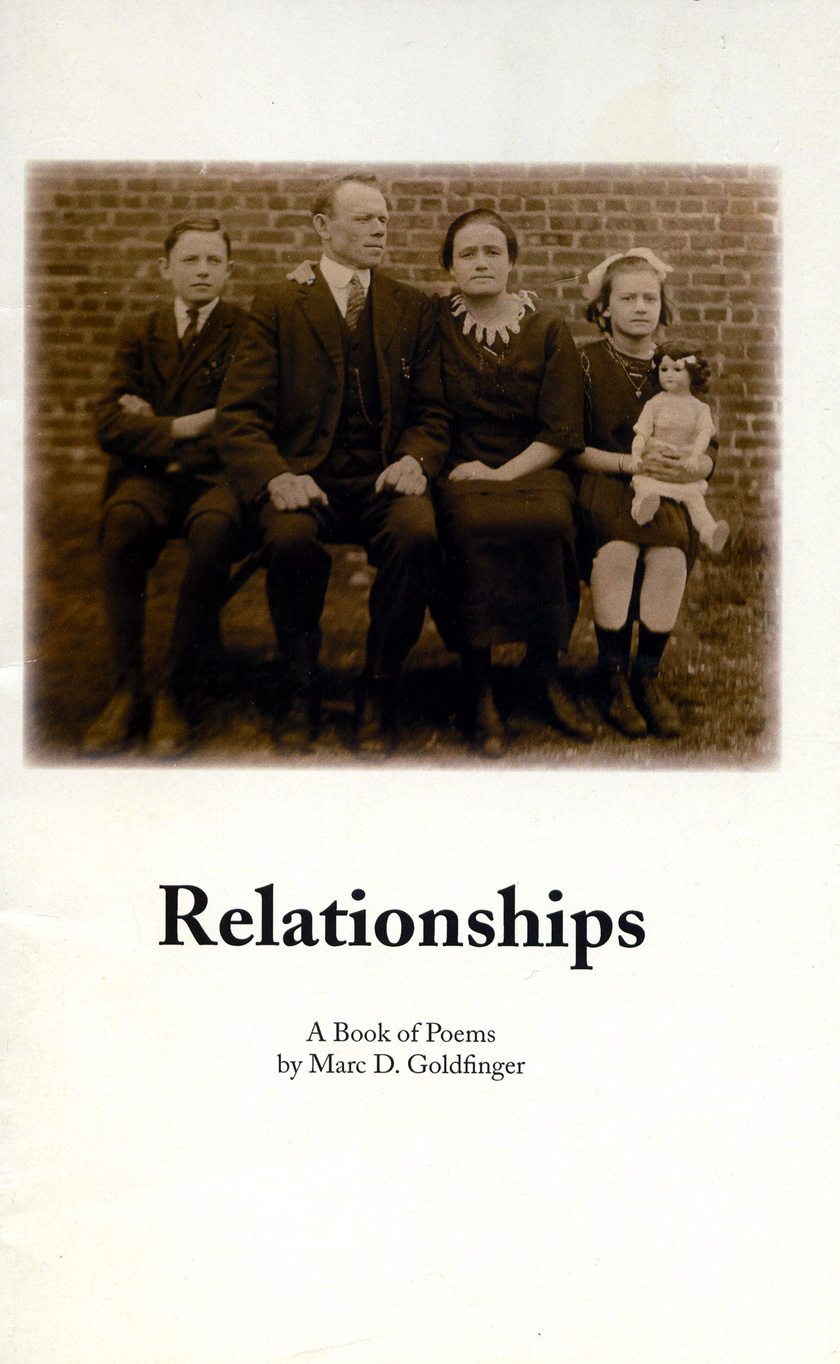
Relationships | Reginald S. Lewis

RelationshipsRelationships  by Marc D. Goldfinger.

Copyright 2003  Ibbetson St. Press   25 School St.  Somerville, Ma.  02143

In this stunningly powerful book of 28 poems, Marc D. Goldfinger purposely eschews the definition of love and relationships as we know it–substituting the cute cupid, fairy tale versions of Juliet’s feverish, almost sickening search for Romeo–for tough, gritty urban poems clearly not for the faint of heart. With a stunning clarity his cast of characters speak for themselves–spinsters and hustlers and junkies and hookers who float zombie-like through the rough and tumble areas of Boston, Gloucester and Cambridge, Massachusetts. In the poem “The Wake Up,” the poet gives us a peek into the single day of a troubled woman named Mary Esther: “…shadows cast by life…grins down the throat of hard luck…and then he kisses her forehead, says, “It’s all right now, breakfast is ready.”

To most of us, unrequited love and adoration is a powerful emotional force in the crucible of the heart expressed in a variety of ways. But in the seedy underworld of drug addiction, the application of love in his poem “Junkie Love” has a different connotation: “…True love/ is spitting the dope/right down the middle/or even/giving her/the bigger cut…”

Goldfinger is not some queasy, apologetic poet. He wears his drug addiction like a badge of honor. Women blow in and out of his life like the wind. They share dope. In a ” A Couple of Kids” Goldfinger is an honorable recorder who witnesses snatches of a conversation between an innocent young teenaged girl who seems totally oblivious to her boyfriend being high on heroin as he rambles on about promises to buy her an engagement ring, relocate to the plush warm State of Florida, where, in a house with a white picket fence, they will live happily ever after. The girl sits in front of the 7-11, begging for spare change. Goldfinger ends the poem with a haunting scene that seems to portend their doom.

Yet like a prolific painter he beautifies the decadent lifestyles of these wayward souls afflicted with the hungry armature of heroin addiction.

And love is sometimes vindictive–like the woman who shredded Brillo into his spaghetti–and laced his heroin with digitalis.

These poems are brilliantly composed with the symphonic smoothness and elegance of jazz. The poet serenades the reader with the lyrical beauty of torch songs. This book of poems by Marc D. Goldfinger is a love supreme.

Reginald S. Lewis is a widely published, award-winning African-American poet, essayist, and a playwright — on Pennsylvania’s death row. He is the author of two books of poetry, titled: “Leaving Death Row,” at  www.1stBooks.com. His most recent book “Inside My Head” is available at www.iuniverse.com and www.amazon.com. To write to Reggie  Reginald S. Lewis #AY2902,175 Progress Dr., Waynesburg, Penn.  15370-8089

How The Troll Met Ar Lain Ta


There’s dope houses and then there’s dope houses. Any junkie knows what I mean when I say that. The dope house of the Troll is like the last house on the block, you know, for the junkie who has tried everything to stop using and nothing works.

The Troll. You’ve probably heard those tales from medieval times where, like the bridge you have to cross to save the maiden, or get to the water so the village can survive, or maybe just cross to get to market everyday has a gatekeeper where you have to pay the toll to get across. Whatever that toll might be. In those ancient stories the gatekeeper was often a hunch-backed creature with hooves for feet, bumps and hair coming off a massive nose, yellowed teeth, some broken, with the breath of a demon from hell issuing forth from his mouth. If you were unlucky enough not to have the toll, you might have to give up some precious possession to get across the bridge and get what you need, whatever that might be, and if you were desperate enough maybe you would sacrifice anything you had, maybe a child even, even the first-born male, just to make things right. But, as any junkie knows, nothing will ever be right again.

He was a modern day gatekeeper at a subterranean basement underneath a three-decker apartment house. The lights were never on in the dwellings above the basement. People were said to live there but no one ever saw anyone coming or going. Now and then there would be screams or cries from above us. The Troll would look up, the furrows on his brow would deepen and he would wink his good eye, the one where red mottled the whites of it, the brown one, not the pale blue one surrounded by yellow with a drooped lid that kept it half-closed all the time, even when he might be asleep, (no one ever knew for sure whether he slept at all or whether that bad eye could see or not), he would wink his good eye at us and say, “The angels. Can you hear them cry? Trapped in a heaven that they never made. Wing rot. They can’t lift off anymore without the help of God. And He’s down here with us, fixing to chase the nightmares away. Heaven help ’em.”

And then he’d chortle and snort from deep into his chest until a hacking cough would cut him off. Usually it would be time for another fix and Veronica de Veux would be slithering through the door with a brick for the gatekeeper.

Veronica. Really, everyone called her Ron so that’s what I’m going to call her for the rest of this tale. Ron de Veux was one of the Troll’s pets. She was a tired old whore, used to be a dancer, used to be a cover girl, used to be a porn star, used to be a call girl, used to be a streetwalker, and at the end no one even called her to the car for a two-bit blow-job, but always a junkie, always a junkie; no man ever moved her like the spike running the horse into her blood. It was the only time she ever came close to orgasm, except maybe when the Troll would roll his creaky wooden wheelchair into the back room of his crib with Ron de Veux right behind him with two loaded syringes. Those of us who knew would perk our ears up and wait. It wouldn’t be long before the moans would start and then suddenly it would sound like a choir of demons mating in twelve-step rhyme from behind that kitchen door. Whatever they were cooking, we knew that we didn’t want any part of it and we’d all drop another bag in the cookers ourselves to dim the lights in our cursed minds.

After a bit the door opened up and they’d come out. She’d be pushing the chair by the cracked rubber handles on the old dark wood and the Troll would wink at us as the spittle ran down his grizzled chin. Ron would be scratching at her crotch for hours after that with a dreamy look on her face. Then she would curl up at the foot of his chair and he would drop two bags into her cooker. The fire from her lighter flashed and within seconds she’d be sleeping with the dustman who was a close relation of the sandman, lord of dreams. The Troll would pull part of the blanket covering his withered branch-like legs down over her and put his grimey gnarled finger to his bearded lips. Sometimes his other pet, Nadia Chance, would be there too, yet she had many other functions in that last house on the block which I’ll go into later.

Then the Troll would start to speak. His low guttural voice would rumble out into the cement and brick basement and echo from corner to corner. Even those of us in the deepest nod would listen up and the basement would get so quiet that you could hear a dull spike skewer the fibrous scar tissue of an overused vein if you were sitting next to someone who happened to be fixing, or maybe the sound of the slide on the barrel of a hypodermic that had been run up and down so many times that even the vaseline on the rubber stopper was locking it up, or maybe even the powder dissolve when the spray hits the stash covering the greyed old cotton in the spoon. Instead of the clink of glasses there might be the ting of the metal buckle on the belt or the creak of the old leather as someone tightened up so they could get a clean hit. Might be that you were listening so hard that you missed the popping of airbubbles in your vein as you overshot the air from the syringe right in after the dope. Don’t worry though, it takes a lot of air to kill an old junkie and we’re not that lucky anyhow.

Did I drift off for a minute or two. Hey, that happens sometimes. Some sentences take an hour to finish, if you know what I mean. Anyway, it would get real quiet and then the Troll would start to spin a yarn.

“Well folks,” he would say, “now that I got your limited attention, let me tell you a true story that nobody will believe if you take it out of here. You can try but remember, who believes a junkie? Heh, heh, no one with any damn sense and you can put your fix money on that any day of the week. I’ll be glad to take it off your hands.

“Did I ever tell you about the four years I spent clean? Hey, I can see the looks you’re giving me,” and he winked his good eye shut, then when he opened it the light flashed out of his pinpoint pupil and he gave out with a soft chuckle. “Really, I’ll tell you, I was a card-carrying member of Narcotics Anonymous going from meetings to detoxes to carry the message of hope for the sick and suffering addict. I chaired meetings and even sponsored people. I kinda do that here too, sponsor people into dreams, let ’em meet the Dustman themselves before they go permanently into the angel’s dreaming in deathtime.”

“My life was going along quite well during that period. Sure there were times that I felt like a little tickle from the old poppy dust would lighten the load. Probably every day it crossed my mind but you know, if you don’t pick it up, you don’t get high. Which is why I make sure that Ron here, “pointing to the sleeping woman at his feet, “picks it up. ‘Cause I sure ain’t in the shape to be rolling up the stairs in those dope houses. I like to stay right here where my dreams live and keep safe.

“You might wonder why I stopped a good run of reality, just like that, when everything was right as ice cream on apple pie. Maybe you’d like to know what it was that kicked me back into the life and made it so that I never want to have an undusted moment again as long as I live.

“Well, if you don’t want to know you can just slip out the door back into the cold and hang out at the auto-mat. See if Jimmy the Greek will take care of your needs and find yourself fixing in an alley or busted by the man and crying the blues in a shit-stained cell out on Rikers. Or you can just sit back, shut your eyes, and let the ole’ Troll tell you why he took this ticket to ride, got on the horse and never looked back.

“It was because of Ar Lain Ta. Maybe you heard old Casey over there speak of him. Maybe you’ve run into him yourself or heard the stories in the other places. I’ll tell you my story about him and then we’ll let Casey tell his, if he’s up to it. Yeah, old Casey met him too.”

Right then I saw Casey pull out another glassine envelope, slit the tape with a cutting blade, and shake it empty into his cooker. Just hearing the man’s name, Ar Lain Ta, that was enough. Casey’s hand shook so much that I reached over, took the gimmick out of his hand, traced his vein with my finger, tapped it once with the point and then slid it in. The fresh blood made a spot at the bottom of the slide and I pulled up on it for a second and then, when the blood plumed up in the barrel, slammed it home.

The Troll continued.

“It was like this. I was sitting in the church in my chair after confession, you know, being in recovery and all had brought me back to the church of my childhood. I was alone there just contemplating my future, like in a state of meditation, when I first caught the scent. You know the smell, that smell when the fire first hits the pipe, or when you walk in the door of an opium den, that sweet smell that lets you know that, no matter what tragic circumstance is on you, you’re gonna be all right as soon as your lips kiss the pipe. It had been a long time since I caught a whiff like that and so naturally I look up to see where it’s coming from. Maybe the priest was coming back around with the incense burner to chase the stench of hell out or whatever.

I look up and he’s standing right in front of me. A man of Asian extraction dressed in a dark suit, very natty, smiling white teeth beaming from his oriental lips and soft eyes looking at me. Where he came from or how he slipped up on me as quiet as the breath of a mouse I just don’t know.

“Lloyd,” he says. That was the name I went by in those old days.

“Huh, how’d you know my . . . ” and he interrupts with

“Ssshhh. It’s okay.”

But right at that moment it just felt all wrong, even the chair I spent all my time in since the war went odd on me and hurt me in places I had forgotten since the last sickness, the last time I kicked in the dark damp cell out at Ryker’s Island.

“Son,” he continued, “you have some unfinished business to attend to. Remember the first time you hit up? You swore to the swamp flies that were buzzing around your head that you would do this the rest of your life. I believe you’re not quite done yet.”

“Hey,” I came up with the retort, “I don’t think you know what you’re talking about.”

“Oh, but I do.” His eyes pierced mine and then I caught the scent of the dope sizzling in the cooker and I peeked around to see where the odor was coming from. Then I realized. By the God on the crucifix, the scent was spilling from his body. It was at that moment that he touched me on the head with his hand and the rush came like I was shooting the pure right from the backhills of Burma.

To be very honest with you, I did not pull away. His hand rested on my head and the rush came and came and the dustman had me in his kingdom. The dreams. Oh my God the dreams. And then he lifted his hand away and it all came to a stop.

We all know what it’s like when the dope starts to leave and the sickness starts to kick in, that melancholy feeling, and then all of the senses sharpen up and the tears start in the eyes, that empty feeling in the stomach when you know, if you had the time, you could write the blues for every junkie, everyman that ever cried out to the deaf Gods in the night. That’s just what happened.

Then he pressed an object which I could not focus on into my hand and whispered an address into my ear.

The last words I heard him say were, “The basement is yours for as long as you like. Leave the angels on the three floors above to their own tortured passage but let your basement be a sanctuary for those at the end of the road, those who, due to sundry losses in their life, need the extreme unction delivered by the opiates. It will be your kingdom, you will be the Troll, you will be the gatekeeper, the one who will grant these souls deliverance. And their numbers will grow as the unrest in the world increases and there will come to you one day a man who will tell you of my doings. However, the knowing will not be for you alone. Another will come to tell the tale to the world and he will write it in the form of a book. Of course, no one will believe him. Who believes a junkie anyway?”

And then there was laughter that echoed through the church. Suddenly I realized that my eyes were closed and I looked up and he was gone. A dream. It must have been a dream.

Just then the priest, Father Michael, came up to me.

“Can I help you out, my son?” he asked.

I nodded my head and he began to roll me up the aisle when I noticed that the fingers of my right hand were clenched tightly around an object. I opened my hand.

In my hand, God help me, God save me, was a brick of heroin with a key taped to the outside. The key fits this basement door. And here we are, all of us, touched by the poppy till death do we part.”

The Troll bowed his head and the quiet clogged our ears. Then this grotesque creature sitting in the wheelchair looked over at me and winked. He winked at me, may God turn my next fix to chalk if I lie, with his bad eye, the drooped one, the one that never moves. And he began to laugh.

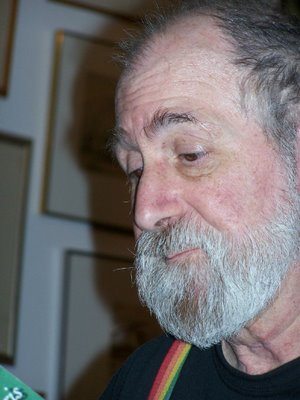
Marc D. Goldfinger is a formerly homeless vendor who is now housed. He can be reached at junkietroll@yahoo.com and via his web page MarcDGoldfinger. Marc also has books on www.smashwords.net that can be downloaded for $2.99.

.

An Ode To My Batterer

You did it over a period of years. I don’t have
quite the same amount of time. You did it
methodically, it was prolonged spiritual
agony, you wanted to make me tiny,
to shrink me beyond that, then melt
me into an even smaller piece. I cried, I miss
trusted my friends, my parents, even myself,
then I was gone. I left, then came back when

you promised things would be different, then
left again. Again. This time I stayed away, yet you
have come after me, time and time, time
and time again. This time you have
caught me, a beast painted into
a corner. The mistake you made was
not in cornering me, but in coming
into the corner with me. Now I have
you. I don’t have the time, I don’t have
the patience to make this last, nor the will
to sustain it. This is my fury. I will lash

you to the chair. Where do I begin, a finger,
a toe, the thumb, no, not the eye, not yet. First
I will stick a pin under each fingernail, the pin
which makes you scream the loudest will
be the finger that gets cut off last. A finger, a
thumb, the big toe, a pin in the pupil
of the eye. A scissor snip of the lip, a razor
cut on the cheek, an eyelid gone. I can’t
understand what you are saying, there goes
the left ear. One spike in the left calf muscle,
a hammer to the right kneecap, water in
the face to bring you back to consciousness.
It is amazing how much punishment the body
can take, another finger, the other thumb,
when you scream this time I will spray
ammonia into your mouth, that mouth

that inflicted such pain over years, maybe
now you’ll scream with your mouth shut
when I set your hair on fire. I don’t think
I have the heart for this, I can’t
go on, even if I burn my hands
in the fire of your hair, now is the time
to tip your head back,

cut your throat.

It’s not over
for me, you fucker, at night you

come to me in my dreams.

Junk Dream II

The dope calling to me again, junk sick, dirty
money clutched tightly in my sweaty palm, I find
myself in the subterranean apartment of the Troll.
The shelves that lined the stone walls were filled
with bottles of blood, a name on every bottle. The
Troll takes a bottle down as I walk in and I ask
what is up with this. He answers,

“This shipment of heroin came in mixed
with the blood of dead junkies; nothing
gets wasted except for our lives.”

I hesitate as he fills an eye
dropper with blood and hands
it my way. Ask if they used
the blood of junkies who had died with AIDS.

“Of course,” said the Troll, “but it’s
only the blood of junkies who died
of overdose; we mixed it with lemon dope
but no lemon juice is necessary. The acidity

of the blood boosts the high.” The sickness
fed my urgency and I watch as the blood
from the dropper disappears
into a metal spike plugged into my vein,
wait for the rush, watch my name
appear on one of the bottles as the Troll
moves his old wooden wheelchair
to the next customer, eyes yellow
with desire, who walks in the door.

“You’re gonna like this,” is the last thing
I hear him say.