
book reviews by Marc D. Goldfinger

The Last Werewolf by Glen Duncan

When are the passing years more than one can bear? Jake Marlowe can answer that question. Jake is a werewolf closing in on his 201st birthday. He’s outlived almost everyone he’s loved and, being a werewolf who shifts into a savage thinking beast every full moon, Jake is challenged when it comes to intimacy.

He has one close friend, a guy named Harley, who, ironically, works for WOCOP (World Organization for the Control of Occult Phenomena) and one of their specialties is hunting and killing werewolves. But Harley loves Jake. And he’s just given Jake the bad news.

A werewolf known as the Berliner was just killed by a WOCOP hunter named Ellis, who was trained by a WOCOP hunter by the name of Eric Grainer, and the death of the Berliner, real name Wolfgang, makes Jake Marlowe the last living werewolf in the world.

It’s tough being a werewolf. Relationships with women are strictly about sex, a lot of it, you see, part of being a werewolf is an extremely high libido. Unfortunately, the song that goes “you only hurt the one you love” happens to be deadly true if you’re a werewolf.

Sure, Jake loves Harley, but there’s no sex involved here, but it is convenient because Harley, being a member of WOCOP, keeps Jake one step ahead of the trackers. But now Jake is the last werewolf. Indeed, that means that the entire focus of the group is on this hunt.

Jake is extremely intelligent and this has helped him become very rich. He owns a number of companies and has numbered bank accounts and stocks under different names, and he’s reached the point where he can easily change identities and go anywhere in the world. But that doesn’t change the terrible fact that on every full moon he changes into a werewolf and kills.

Jake has tried killing animals but nothing satisfies like human blood and meat. This, as you might guess, has some extreme drawbacks. Oh, yes there are vampires in the world too. However, vampires have the gift of speech. They have become very organized and rich. They are primary funders of WOCOP, which is aware of their existence, and the hunters leave the vampires alone as long as they follow certain rules.

Werewolves and vampires hate each other. To quote from the book, “A vampire has written: ‘the great asymmetry between immortals and werewolves (apart from the obvious aesthetic asymmetry) is that whereas the vampire is elevated by his transformation the werewolf is diminished by his. To be a vampire is to be increased `in subtlety of mind and refinement of taste; the self opens the door of its dismal bed-sit to discover the house of many mansions. Personality expands, indefinitely. The vampire gets immortality, immense physical strength, hypnotic ability, the power of flight, psychic grandeur and emotional depth. The werewolf gets dyslexia and a permanent erection. It’s hardly worth making the comparison.’”

Obviously there is extreme prejudice between the two. That may be because the werewolf can be sexually active; vampires can’t. That, itself, can cause hatred between the two species. Werewolves can communicate with each other telepathically, but they don’t run in packs; they are solo. And, as far as anyone knows, there has not been a female werewolf. It takes a certain type of stamina to survive the bite of a werewolf; not many do, and it has been a long time since anyone has.

Which brings us to a world where all of WOCOP’s forces are focused on the last werewolf—Jake Marlowe. And Jake has had enough of life. The yearning for a mate has worn him to the point where he suffers from extreme depression. WOCOP, because of the way they operate, only get satisfaction from killing the beast, not the man. So they must wait and be there when Jake turns.

Jake has always avoided them in that narrow window of time because of his friend Harley’s help but this is the first time that all the focus is on him. And it’s quite possible, by now, that Harley is suspect. Between that and Jake’s depression, it appears that, if this were a game of cards, Jake is ready to fold.

Ah, but! I’ve told you nothing, no spoilers, no wreckage of the tale. The Last Werewolf is written by Glen Duncan, a brilliant young novelist who is very well read, and he lives in London. Duncan is a literary master and spins a yarn that will keep you warm in cold weather. Like The Girl With The Dragon Tattoo, the book begins slowly, so you must sip it like an extremely hot bowl of delicious chocolate.

Next, this book is no “Twilight” referring to the vampire series written by Stephanie Meyers. Not to knock that series but, in comparison, that series is “monster lite” whereas this is Poe mixed with Neil Gaiman. Glen Duncan is a writer’s writer, using many literary references to spice the drink.

The Last Werewolf is literally one of the best werewolf/vampire books I have ever read. There is also a special treat that goes along with this book. It has to be bought separately though. It is a CD by a group called The Last Tuesday Weld and the name of the CD is The Last Werewolf—A Soundtrack.

Glen Duncan takes part on the CD with words from the book. Excellent to listen to the CD and read the book at the same time if you wish. The book is available at The Harvard Bookstore in Harvard Square and the CD is available at Newbury Comics.

There are many twists and turns on this haunted verbal road. I highly recommend it. If it is done right, it would make a wonderful movie. The Last Werewolf is a Borzoi Book published by Alfred A. Knopf. It was originally published in Great Britain by Canongate Books, Ltd., Edinburgh. There is a quote from the Selected Poems of Thom Gunn within the story.
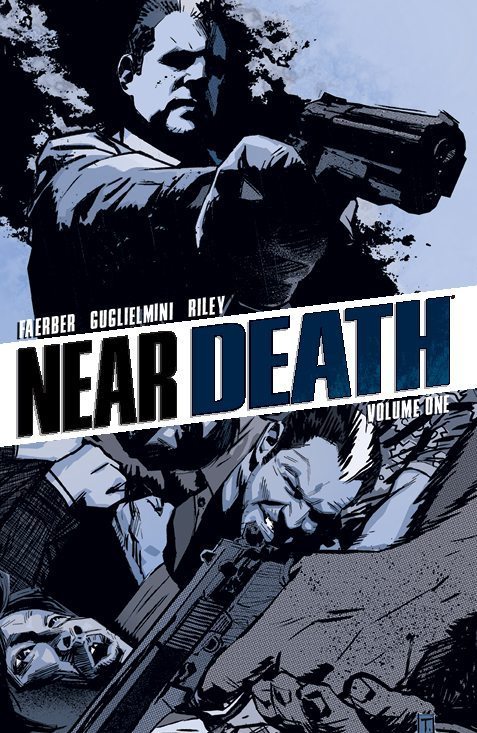
Near Death | Well Jay & Simone & Team

Well Jay & Simone & Team

Great read. I picked up Near Death as an extra and now I’ll have to put it on my regular pull list at my shop Comicazi in Somerville MA. This is as good as Criminal by Brubaker; I’m sure you’ve seen it. Even the art is comparable. If you keep going like this, you have a killer on your hands, if you know what I mean. I understand the art being placed in Seattle, just as Stumptown was placed in Portland, Oregon.

I recognize both places; I lived in Portland while I was a fugitive for two years; finally got caught and rendited back to Massachusetts after a 3 month legal battle. But I miss Portland. The West Coast gets in your blood but I’m settled now and write for a small newspaper called Spare Change News that helps people in dire straits get back on their feet.

I started with them when I was a homeless junkie and now I’m clean, happily married and comics have replaced heroin as my addiction. Just ask my wife. Your portrayal of the underworld is realistic and the story in Near Death just pulls the reader along. I did a poetry reading while I was serving time and the tier was going crazy and all of a sudden I realized that I was pulling everyone towards a riot. They were chanting, “Goldfinger, Goldfinger, Goldfinger.” So I pulled back and started reading love poems. Slowly the mood died down. After it was over one of the guards thanked me for slowing it down. When I got back up on the tier one of the hard cases said, “Why did you take it down. You had ’em. We coulda ripped out!”


Well, the last thing I wanted to be in the middle of was a prison riot. Especially when the finger pointed to me as the instigator.

In prison some of us grow up; some of us get harder. In Near Death Markham, your “hero” has had a life-changing experience. He’s still in the game but in a more dangerous sort of way. I’m looking forward to your continuing tale. You guys are the balls!

By the way, if you haven’t checked it out yet, a good show on TV is called Breaking Bad. It’s well-done with good character development and suspense. It’s realistic too. I know. I came out of that world alive. — Marc D. Goldfinger

Gregory David Roberts | Shantaram

Shantaram, by Gregory David Roberts: A Book Review

My daughter gave me a soft cover edition of this book. I held it in my hands and looked at the massive size of it. I flipped to the back and thought, “Good God, 936 pages. I’m never going to get through this.” I almost put it aside and then I turned it over and read the blurb about the author.

Gregory David Roberts, born in Melbourne, Australia. It appears that he was sentenced to 19 years in prison for armed robbery. Why? Because he was a heroin addict. After serving 10 years, Roberts escaped from prison and went to Bombay, now known as Mumbai, in India, where he lived for ten of his years as a fugitive.

Okay, I was interested. So I started reading. I was hooked almost immediately. As I continued I realized I was experiencing one of those rare times for an avid book reader. This was a book I did not want to end. I was ecstatic that the book was so long. And it kept getting better and better.

Unbelievable! While I was reading Shantaram, I actually kept bursting out in laughter. How many books can do that? I don’t mean that I was chuckling quietly to myself. I was exploding with laughter. Come. Let me give you a small taste. After a long trip across part of India with Gregory David’s friend Prabaker, who called Gregory ‘Linbaba’ for most of the time, they had arrived at Prabaker’s small village.


(Excerpt begins.)
“Prabaker said, “You must have a bath, Lin. After such a long travel you must be smelling unhappy. Come this way. My sisters have already heated the water on the fire. The pots are ready for your bath. Come.”

“We passed through a low arch, and he led me to an area beside the house that was enclosed on three sides by hanging tatami mats. Flat river stones formed a shower base, and three large clay pots of warm water were arranged near them. A channel had been dug and smoothed out, allowing water to run off behind the house. Prabaker told me that a small brass jug was to be used to tip water over my body, and gave me the soap dish.

“I’d been unlacing my boots while he spoke, and I cast them aside, threw off my shirt, and pulled off my jeans.

“’Lin!’ Prabaker screamed in panic, leaping, in a single bound, across the two metres that separated us. He tried to cover my body with his hands, but then looked around in anguish to see that the towel was on my backpack, a further two metres away. He jumped for the towel, snatched it up, and jumped back, giving a little shout of panic – ‘Yaah!—each time. He wrapped the towel around me, and looked around in terror.

“’Have you gone crazy, Lin? What are you doing?’

“’I’m trying to . . . take a shower . . .’

“’But like that? Like that?’

“’What’s the matter with you, Prabu? You told me to take a shower. You brought me here to take a shower. So, I’m trying to take a shower, but you’re jumping around like a rabbit. What’s your problem?’

‘You were naked, Lin! Naked, without any clothes also!’

‘That’s how I take a shower,’ I said, exasperated by his mysterious terror. He was darting about, peering through the tatami matting at various places. ‘That’s how everyone takes a shower, isn’t it?’

‘No! No! No, Lin!’ he corrected, returning to face me. A desperate expression contorted his normally happy features.

‘You don’t take your clothes off?’

‘No, Lin! This is India. Nobody can take his clothes off, not even to wash his bodies. This is India. Nobody is ever naked in India. And especially, nobody is naked without clothes.’

‘So . . . how do you take a shower?’

‘We wear it the underpants, for having a bath in India.’

‘Well, that’s fine,’ I said, dropping the towel to reveal my black jockey shorts. I’m wearing underpants.’

‘Yaah!’ Prabaker screamed, diving for the towel and covering me again.

‘Those teeny pieces, Lin? Those are not the underpants. Those are the under-underpants only. You must have it the over-underpants.’

‘The . . . over-underpants?’

‘Yea. Certainly. Like these, my ones, that I am wearing.

“He unbuttoned his own trousers enough to show me that he wore a pair of green shorts under his clothes.

“’In India, the men are wearing this over-underpants, under their clothes at all times, and in all the situations. Even if they are wearing under-underpants, still they are wearing over-underpants, over their unders. You see?’” ( Excerpt of Shantaram.)

The clash of cultures is so well done and so humorous that I couldn’t stop laughing. Even when lives are at stake, and that takes place in this marvelous story, there are moments where you will not be able to restrain your laughter. Or your tears. Yes, there are times when I cried, literally had tears spilling down my cheeks.

This is the story of a man traveling through life, fighting his demons of addiction, falling in love, and meeting people in unusual circumstances. Linbaba, or as he is known in Australia, Gregory David Roberts, is on a journey of growth, an epic tale that is unbelievable. But true.

Like I said before, this numbers among one of the ten best books I’ve read in my life—and I’ve read many. I read books like people eat happy meals. Sad to say, I’ve finished the book but I will go back to it.

My wife is reading it now and the she is laughing out loud too. I’m watching her read and loving her enjoyment.

You could say I’m a bookworm. I’ve never read a more realistic description of drug addiction. Gregory David Roberts has a special way of reaching the heart. His heroin addiction is minor part of the entire book yet he does it better than William Burroughs. Upon reading this book, I had to have a hard cover signed edition — book collector that I am, so I bought it from an Amazon vendor. However, I’ve seen this book at The Harvard Book Store in paperback. This massive book brings Bombay, now called Mumbai, a city in India, to life. So wonderful, I just can’t praise it enough.

In brief, Gregory David Roberts, a career criminal because of his addiction, escapes an Australian prison after serving 10 years of a 19 year sentence and travels to Bombay. And the odyssey begins. A guide named Prabaker is one of the warmest human beings I’ve ever met in the pages of a book. If you’ve read a book and never wanted it to end, then you know how I felt about Shantaram. Wonderful, heartbreaking, exciting, uplifting! I can’t say enough about it. So I’ll stop right now! — Marc D. Goldfinger

Shantaram by Gregory David Roberts—St. Martin’s Press, N.Y., N.Y.

Dire Means by Geoffrey Neil

We will never have peace in the world until men everywhere recognize that ends are not cut off from means, because the means represent the ideal in the making, and the end in process, and ultimately you can’t reach good ends through evil means, because the means represent the seed and the end represents the tree. — Dr. Martin Luther King, Jr.

I found this book through a friend on line; it seems that stores generally don’t carry it. It is a story about one man and his organization who decides that he will end homelessness once and for all.

Now Spare Change News is a paper that deals with homeless issues so I felt duty-bound to read and report on this book which, unfortunately, has not received much press. To be honest, I wasn’t looking forward to it. I thought I would be slogging through a 300+ page book, but like I said, because it dealt directly with homelessness, I felt I could not ignore it.

Was I in for a surprise!! Before I had read ten pages I was gripped with the desire to find out what would happen next. Then, even after I was hooked, the intensity began to build and I found myself totally engaged with the lead character, a 28 year old computer techie named Mark Denny, and the situation into which he found himself thrust.

You know the expression, “No good deed goes unpunished.” Well, it certainly applies here, and by page 36 Mr. Denny finds himself knee-deep in it. Little does he, or the reader, know that upcoming twists and turns will find Mark Denny a public figure, heroic in scope, with his position constantly shifting.

If you have never been homeless, you must read this book because you will, through the author’s skill, find yourself identifying with what it is like to be homeless. If you have been, or are homeless, you should read this book because you will find yourself saying, “Yeah, I’ve been there; I know what this feels like.”

Well done, Geoffrey Neil, well done.

As I said earlier, I thought this book would be a chore to report on. How wrong I was! I found myself gripped by the tension and flipping from page to page. I literally couldn’t put the book down.

It was a weekend and my wife, as understanding as she is, said to me, “Well, are you going to spend the weekend with the book or me?” in more ways than just verbally. But I was hooked.

From the moment that, for selfish reasons, Mark Denny decides to help two scam artists harassing drivers for “gas money,” he finds himself in a predicament that would give PTSD to anyone to the moment, soon after, where he is attempting to rescue a “homeless” man from a certain suicide because he really wants to be a good guy, the story whips into the fury of a hurricane.

The story takes place in Santa Monica, California. People are disappearing at the rate of one a day. We’re talking business executives, rich housewives, arrogant teen-agers, average middle-class citizens, not homeless people at all.

Then, days later, they start to reappear, dead, with camera footage from digital cameras hung around their necks showing them abusing, either verbally or physically, homeless folks. Their Cause of death—starvation and thirst.

Santa Monica goes into panic mode. All of a sudden no one wants to abuse, through neglect or otherwise, homeless people or people who appear down on their luck.

Because of his selfless act on the roof, saving a “homeless” man from suicide, Mark Denny’s hero status brings him into contact with the very people who are “disappearing,” the abusers. And he finds that, somehow, someway, he is the only person who can bring the horrific means these people use to end homelessness to a halt. That is, if he can survive.

It is amazing how quickly one can go from hero status to fugitive status. Mark Denny finds himself brought into this organization which operates with technological expertise, lethal manipulation, and is a trusted information disposal company which, by its very nature, escapes suspicion and is held in extremely high regard by the business community.

Imagine having access to financial information, medical information, family history, etc. and using this knowledge to alter society for “altruistic means.”

Mark Denny, the hero, the computer expert, the homeless sympathizer, is brought into this organization and, little by little, the doors are closing behind him, and, before he knows it, there is no way out.

I could say more but why would I want to? This is a book that must be read. I guarantee you will be turning pages and ignoring everyone around you.

What’s the difference between a homeless person and yourself? One wrong corner turned, a hurricane, a mugging or an information specialist with a Taser.

Access to Dire Means can also be found on Facebook. I had mine specially ordered from the Harvard Coop. Dire Means copyright, 2009.

Please Note: much more on Goeffrey Neil can be found via his web page by clicking here…