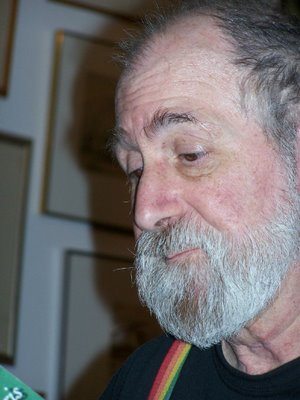
Marc D. Goldfinger

The Vendor


Upon reading “Let Us Now Praise Famous Men” by James Agee, the thought struck me that you, the reader, have truly so little understanding of the people you purchase this paper, Spare Change News, from, standing outside in frigid weather, hot weather, rainy weather, stormy weather, dancing back and forth to keep our feet from freezing, and not even realizing when frost-bite has taken it’s toll on certain bodily extremities, including the nose.

I speak as one of those folks who came out to Central Square and stood on the corner of Tremont Street and Massachusetts Avenue, on Monday through Friday from 7am to 5:30pm, with only a brief bathroom break, eating my lunch as I sat on the stone ledge of the bank I sold the paper in front of, working as I ate.

From time to time, a person would look at me and say, “why don’t you get a job?” and I would politely reply, “if you do not think this is a job, why don’t you try standing out here for 8 or more hours a day selling a product?” On occasion, the person would stop and purchase a paper, some of them becoming regular customers.

These Vendors, and I include myself, go out each day and have no idea whether they will make $10 or $45 as a days pay but, as we are, we accept what we must do to make an honest living. We are driven by our desire to make money so we may eat, obtain clothing suitable to the job we work and, most importantly, put together enough American Greenbacks so we can find a place to live that, for the moment, we can call our own.

Remembering well some of the folks who have appreciated my writing and purchased the paper from me; still they contact me to ask what I have written and because I have stores of written word I can cobble together a book of prose and/or poetry that will titillate their consciousness and it pleases me that they recall this shattered man who stood on the corner on days so cold that, on one of them, my nose exploded from frost-bite.

This kind customer said, “Marc, whatever is wrong with your nose; it’s twice the size and has frozen blood all over it?” I stood astounded as she said this to me because I was so cold that I did not feel my nose on my face and when I reached up to touch it, my customer stopped my hand and said, “no, don’t hurt it more,” and took me into the 1369 Coffee Haus down the street, buying me coffee and telling me not to go back out in that frigid weather. Respecting her judgment and being utterly shocked when I peered into the bathroom mirror and did not recognize my face.

My brothers and sisters who are still out selling in the cold, and this winter has been particularly bitter; my heart goes out to them for I am them despite the fact that the woman, Mary Esther, who loves me so, makes it possible for me to earn money without standing in the cold.

But what brought me to this state of chronic homelessness in the past; what insidious affliction took me, a child of middle class means, who by all rights should have completed university study and become an associate professor of literature; how could this have happened. The Sickness, and I capitalize this on purpose, was brought about by the way I was walked into the world by those who claimed to love me, and possibly did, but were cursed by those who beat their world views into fractured prisms; it was their parents indeed, and even before them.

Taught to hate myself in my formative years, set up to failure and twisted my mentality where only drugs, in the shape of opiates could bring my Spirit peace; as I grew out of my teen-age years the Sickness wrapped its tight hands around the throat of my being and throttled me until I found that I no longer fit in the world as a human being; cast out by my own mind until the street corner was my home.

The street corner became my office where I held court with other broken beings but the paper I sold, Spare Change News, was the beginning of the cure that broke through my Illness and where I found true peace. Those of you who passed me money throughout the day and gave me kind words to take with me, I thank you and make this promise: I shall not return. When you see the men and women who sell this paper, who work hard under difficult times and weathers, give them more than money because they are searching for their own true God.

The Past, The Present, The Future of Prohibition


I’m driving the red pickup truck through the snow. It swirls around and it is so cold that it just blows off the road like dust. Sooner or later I know it will start to stick but I don’t care. I’m sick. That’s an understatement. Tears spill from my eyes and my nose is running.

I don’t know if it is because I am crying or just afraid of everything. My wife Sascha and my fair-weather friend Richie are in the truck and we’re all in bad company. My stomach is cramping from the lack of heroin but that’s just the way things are.

No one in their right mind should be on the road in this storm. On the radio they are telling everyone to stay home and there are only fools, police & junkies on the road right now. We ride the back highways from New Hampshire heading for the Great Brook Valley Projects in Worcester. It takes an hour on a good day doing about 75 miles an hour but today it will take an hour and one-half.

I want to turn the truck around and just go home because I’m sick and scared. I lost my license to drive last year in November; just about the same time of year it is now. Thanksgiving is right around the corner but that doesn’t mean much to Sascha or me right now.

The storm rages, the radio is blasting, the truck holds the road well weighted down with sand bags in the back. No one speaks. There is nothing more miserable than a truck full of sick junkies.

We hit the main highway now, Interstate 290, and within twenty minutes we are coming down the exit ramp by Great Brook Valley. The road is slippery now and I’m trying to use caution, but God, I’m in such a hurry. I just want to get well and feel that heroin coursing through my veins.

It won’t be long now. I know the snow won’t keep the dealers in; their sickness drives them to work too. I’m thinking that on the way back Sascha will fix up my hit and bang my big vein while I drive. No sense stopping anywhere. The bathroom we used to use in the McDonalds is too dangerous and you can’t just sit still on a side road. It’s much too dangerous.

There are only two roads into the Great Brook Valley Projects. You’d think they could keep the dope out if they tried but that would put them out of work. Ever since Prohibition for alcohol ended the police switched jobs. This is the new prohibition and it’s 1987 and nothing has changed.

The roads in the Valley are snow-covered and I slow a little but not too much and then all of a sudden this dumb cat who wasn’t looking opens his car door right into my path and I try the brakes but I’m losing control and I take his door right off.

“Jesus”, Richie says, “we have to stop.” But I see the dope man just up the road and we’re holding needles and hypodermics so if we stop we’re screwed anyway. I say we go for it and pull right up to the guy with my hand out the window holding five fingers up with the money showing.

The dealer waves to a little kid and the kid comes running over and hands him the dope—he hands it to me and I give him the money and we take off in the big red pickup with a smashed right fender.

Sascha says, “Go, go, go” and I do, whipping out the other road to get free from the Projects. Two blocks away I see a shopping center and I don’t want to wait anymore. I pull in between two cars and we all get out our gear and pour water and there are three spoons cooking with Bic lighters filled with dope and a bit of a cigarette filter to draw up the stuff.

And then it happens. There are blue lights all around us and I whip up my sleeve to shoot before they can grab me because there’s nothing worse than going into the holding cell dope-sick.

But I’ve run out of time and they’re on us like blue pit bulls—Richie got his shot in and I drop mine still full and we have one extra bag that will be the coup de grace.

They pull me out of the truck and slam me against it while they use those nasty plastic handcuffs and crank them tight. My hands will be numb from blood loss and we’re all down for the count.

I can’t believe that guy opened his door right in front of me but that’s a whole different story and this is just a bad memory now. It’s November of 2013 and everything has changed.

I’m coming out of a meeting, and I’m talking to a friend of mine who works Worcester as a Probation Officer. Just for the heck of it I ask him about Great Brook Valley Projects. He says, “It’s still the same. People coming in and out to cop and now they are all young white kids. It’s hard to believe that nothing has changed but, for me, it’s just job security.” And I laugh. Because I can laugh now; the old days are just nightmares and stories to tell.

I’ve been abstinent a long time and instead of living on the streets, where I wound up after doing some time in prison, I’m happily married and I treat my illness with meetings, a social worker and an excellent psycho pharmacologist who prescribes Suboxone for me.

I’m a member of the Board of Directors of the Spare Change News, the paper I sold when I was on the streets—my first honest job that helped me straighten out my life. One of the other Board members, Bob Woodbury, sent me an article about Suboxone from the New York Times that focused on much of the negatives about the psychiatric medication and he had this to say, “Suboxone (like methadone) is a miracle drug for people who want to get off heroin or other opiates — and, like methadone, it’s subject to abuse by physicians looking for a buck and addicts looking for money or a high.

I think the [date] “New York Times” article takes the therapeutic benefits for granted (limited news value there), and focuses on the abuses. But I read the message not as “this therapy is bad” but “we should manage distribution of this potent drug better” — a concern I believe you’d agree with.”

I did agree, to a point, but I had this to say,” I think we should manage all potent drugs better–including alcohol.  I don’t know if you saw the movie Traffic, based on a European series called Traffik, but you see all these hotshots of the drug war drinking like crazy while their children do drugs.  And everything goes bad–except for one Mexican cop who sets up a deal with America behind the scenes–a great actor named Benicio Del Toro–and makes it work for his people.  The U.S. drug czar is Michael Douglas who always has a drink in his hand–while his daughter gets hooked on chasing the dragon(smoking heroin).  Great movie.

Prohibition is still with us–and it’s getting worse all the time. They are even selling drugs on the internet on sites like Ebay—one of them is called The Silk Road, which was shut down for a short time when one of it’s founders was arrested for conspiracy to murder. But that’s the rarity when it comes to the internet. Opiates, steroid, and other drugs are available and one one site goes down, others go up.

I’m just glad that I’m treating my illness and I don’t have to be afraid anymore.

You Get What Anyone Gets

Please click the image above or just click here… if you want to donate for Joe’s medical expenses. In times like this we all think, “I wish I could do something to help.” You CAN help, and here’s how: donate to the Joe Gouveia Recovery Fund to help with bills during this fight against cancer! Every dollar helps, so no donation is too small. Please keep Joe in your thoughts and prayers. Thank you for your support!

For José Gouviea

Outside Club Passim, before the show
the reporter asks if JoeGo will give her
a ride; he nods his head, throws his long

leg over the Harley, and says, “Let’s go.”
And she does, but she doesn’t let go; she
holds JoeGo tight around his waist as the

engine roars and he whips out the back alley
onto Brattle Street. I look at my watch and
see that the show is supposed to start in 5

minutes and wonder if they will get back
in time. In time. In time. We’re all running
out of time but most of us don’t think about

the short lifetimes we live; we live as if it was
going to be forever. 30 seconds before the show
starts, Jose rolls in, the reporter is laughing and

even after he stops she clings to his waist. “It’s
over”, Jose says to her, and she looks at him
and she knows she doesn’t want it to be over.

None of us do; who doesn’t reach a period in time
where we think we want to live forever? But
then time has it’s way with us, like a masochistic

brutal policeman with mace and a club, beating us
until we cry out, No Mas, No Mas, but still, when
the cop turns away, we stand up, brush the blood

onto the road where it belongs like an oil patch
waiting on a sharp curve. Jose rides out alone
after the show, cranks the gears with his toes,

faster, faster, faster, he can’t go fast enough, he
can’t write enough poetry to feed his hungry soul,
but he will ride and write until the bike hits the

patch that he left on the road and goes spinning
wildly out of control. This is the big SLIDE, he
thinks, and then he wakes up in the hospital.
“What am I doing here,” Jose says, “I still haven’t
written my Ode To Life,” as the doctor walks in

and says, “I have bad news,” but Jose isn’t ready
to hear it. He gets out of the bed, rips the IV out
of his arm and puts on his boots. Jose is walking

outside to get his Scoot, looks around, and there
it is, standing up on one wheel, still and silent, there
is a woman dressed in Black sitting on the sit and

she crooks her finger at him, says, “Get on”, and
Jose sees the Bike pointing upward and says, “Is
that all there is?” And she smiles and says to him

as she takes off her blouse, “You get what everyone
gets, Dude, You get a lifetime.” Jose hops on and
the Babe holds him tight as they disappear into the sky.

The Turning Point: Doctor Sleep by Stephen King

“We stood at the turning point. Half-measures availed us nothing.” The Big Book of Alcoholics Anonymous

I’ve been reading Stephen King since I was young. Let me make this clear: young is a variable for me. The first book I ever read by Stephen King was The Stand, a book of about 800 pages. It was supposed to be longer but King’s publisher didn’t think a book that ran over 1100 pages would sell, so they asked King to cut, cut, cut, but no pasting, until they felt it was marketable.

The ravaged version, which, by the way, was great, came out in 1978. Years later, when King’s popularity was peaking, they released the full version. This was in 1990. It is now 2013 and Stephen King, after completing his magnum opus called The Dark Tower, is at his best.

King’s newest book, Doctor Sleep, was just released (528 pages). Way back when King was starting out, he wrote a book called The Shining, which was later made into movie starring Jack Nicholson. My guess would be that more people saw the movie than read the book, although the book sold quite well. The Shining has 447 pages, which makes it one of King’s shorter novels.

To appreciate Doctor Sleep, one does not need to go back and read The Shining, however, it might add some flavor to the experience. Loosely speaking, they are sequential.

The main character in Doctor Sleep is Dan Torrance. He is in his early 30’s in Doctor Sleep; in The Shining Dan Torrance is a little boy who sees more than the normal person. To be hyper-aware is not always a gift. If you can shake someone’s hand and see their imminent death, it’s hard to smile and say, “Have a good day and it was nice to meet you.”

As an avid reader, I hate book reviews that spoil the fun, if that would be the proper word to use for one of Stephen King’s books. I find myself faced with a conundrum. I don’t want to spoil Doctor Sleep. But I do want to tell you why I think it is Stephen King’s best book.

It’s quite different than his 7 book Dark Tower series- which is the modern Lord of the Rings. But Doctor Sleep touched me in a very special way.

If you happen to be an alcoholic in recovery, you will love Doctor Sleep. Boy, I put myself out on a limb there, didn’t I? But really, I mean it. Even if you’ve never read a King book before, if you are in recovery, just pick it up and read the first ten pages, including the quotes at the beginning of the book.

I’ll go one step further. If you’re an alcoholic or a drug addict who is still using but doesn’t want to use anymore, pick up Doctor Sleep and read it. Then go to an AA meeting or an NA meeting. You don’t have to wait until you finish the book. After all, you’ll want to be sober enough to remember the damn thing, right?

Just like Dan Torrance had the Shining when he was a child, in Doctor Sleep there is a little girl named Abra Stone who Shines like the sun. She’s got some power, all to the good.

There are other folks cruising down the highways and byways of America. You’ve probably seen them in their big RV’s, mostly retired people who are past their mid-sixties. Looks are deceiving my friend. Just like there are motorcycle clubs called The Devil’s Disciples, it could be that not all of these old folks have warmth in their hearts.

There is a gang of them that calls themselves The True Knot and they hunger to live. What they need is children who Shine and, just like vampires drink blood, these folks drink the Essence of the children. No, no, the children don’t survive. The True Knot has been around a long time. They traveled in covered wagons back in the day.

And, just like true Bikers, these folks have names like Steamhead Steve, Black-eyed Susie, Diesel Doug, & Steve the Chink, who is not Chinese. Their leader is a big woman who wears a sinister top hat and they call her Rosie the Hat.

They don’t like dogs and dogs don’t like them but they love children. Children who Shine. You know that statement from the old rock songs, “you always hurt the one you love”. The True Knot does just that.

Abra Stone picked up on The True Knot when they were draining the Steam from this young man, about 12 years old and never to see another birthday—she hooked in on what they were doing with her Shining and began to scream as she pulled away.

Not quick enough. Rosie the Hat sensed her and knew that, whoever that young girl was, she was definitely a large store of food for The True Knot. And that’s all I can say about that because I don’t want to ruin the story for you.

Dan Torrance, who we talked about before, has a job to do. When the teacher is ready, the student will appear. That’s an old saying. I don’t even know where it came from but it definitely applies here. But this is enough about Doctor Sleep. I’ve probably told you more than you want to know. This is Stephen King at his best and his heart is really in this book.

All of us, one way or another, reach a turning point in our lives and we either take the path we were meant to take—or we slip down the dark road. I’ll have to say that I was lucky and took the right path after 30 years of dark road. But it’s never too late for anyone as long as they are alive.

Now I get to read and collect these books, of which Doctor Sleep is one. Even if you don’t like to read Stephen King, this is the book to jump on. If you like it, pass it on. If you don’t like it, well write to me and complain. I’ll hear you out.

But watch out for caravans of RV’s with those bumper stickers that say “Old but not dead, save Medicare, I’m a conservative and I vote.” You never know whether they’re out hunting or Sight-seeing.

Oh, Doctor Sleep works in a Hospice. We come to find that the ties that bind a family together are stronger than we believe. The truth is always just one stranger away.

Whether you are a friend of Bill’s or just a close cousin, this is not a book to miss.
_”DoctorSleepBook.com”—SimonandShuster.com”

Where The Highways End


Way back, in the way back of the late late 1800’s, the first automobiles rolled down the dirt roads. The age of the combustion engine that took us places had been birthed. If we knew now what we didn’t know then, would we have proceeded to build the highways and byways of the rough beast?

At first there were just byways, and when people saw an automobile, they all gathered around in wonder. Some laughed. Some envied and wanted one for themselves. After all, the question of exhaust didn’t exist. Exhaust was likened to a horse farting after it dropped a load on the dirt roadway.

Little by little, more and more people, mostly the rich, bought the horseless carriage and the commoners did envy them; those that weren’t laughing. There was the old cartoon where the wagon drawn by the horse pulled up to the broken down automobile and said, “Get a horse.”

But the die was cast. Henry Ford, master of the production line, figured out a way to build cars so that even common working folk could buy them. Ford went forth and did this and soon, people were clamoring for roads that would be worthy for their horseless carriages, the beasts with the horses under the hood; the beast that never shit but farted into the atmosphere non-stop.

100 years might seem like a long time to the average human being, who lives less than that, unless they are lucky or kissed by genetic qualities that grant them longevity. But just one century later, our country was filled with roadways and everyone, but a few, had an automobile, or maybe two or three per family.

When I was in Livingston High School back in 1962, the school even had a student parking lot and everyone, barring a few, yearned to turn 17 years of age so they could get the magic ticket that would allow them to drive. I went from bicycles to hitchhiking rides, to owning my first car, which was a big eight-cylinder Plymouth Belvidere flip-top, with the unique gimmick of a push-button transmission.

That gimmick didn’t last too long. It was too easy to blow the tranny and many folks did. I wasn’t one of them though. What happened to me was, the linkage from the gas pedal to the carburetor got stuck, and down the road I raced, popping the neutral button when I wanted to slow down, and it was the engine that blew instead.

I used to call myself, when it came to cars, “a final owner”, because when I possessed it, I was the last one to have it before it went to the junkyard. Gasoline was 29 cents a gallon, not much more than the price of a pack of cigarettes from the smoke machine; put a quarter in and you get a pack of Lucky Strikes with two pennies taped to the pack for change. Life was different then.

We even went cruising for fun, down the highways and the byways. Of course, the byways were rapidly turning into four lane roads. In California, the roads were sometimes twelve lanes wide and filled with cars, from stem to stern. At rush hour, when people were going to work and back, the highways turned into giant parking lots because there were just too many cars.

Of course, humanity didn’t get the picture yet. If 100,000 horses let out an occasional fart before it dropped a load, it couldn’t compare to millions and millions of cars with exhaust pipes that never stopped pushing carbons. It’s not pleasant to stick your nose in an exhaust pipe and only a few dumb kids used to do it for kicks and then they would fall to the ground with a bunch of dead brain cells. Humans are like that.

Now I want to paint a picture for you. Look around at all the cars in your city. Let’s take Boston, because I live in the Boston area, and we have a lot of highways that turn into parking lots during rush hour. While the cars are sitting still, with their passengers listening to music or talk talk radio, the cars, trucks & buses never stop farting carbon exhaust into the air.

Imagine, if you will, if you could fuse all the exhaust pipes in the Boston area into one big pipe—how big would that pipe be? I’ll bet you’ll have trouble visualizing it, because, as smart as we think we have become, our minds have certain limitations. Now take that exhaust pipe, Boston’s pipe, and fuse it with all the exhaust pipes of all the cities in the world. That’s mind boggling, isn’t it? And they only stop farting when they’re shut down, and there are always cars, buses, & trucks that are running.

I don’t know how many combustion vehicles there are but it appears that there are enough running that our atmosphere is changing and the Earth is being altered. Ice caps are melting, storms are increasing in intensity, and the shorelines are being inundated with water. Why, even the subways of New York City, during a hurricane named Sandy, were flooded with water.

The New Jersey shoreline has retreated as the ocean is creeping up on us too. Who could have imagined that a few horseless carriages could have multiplied like rats in a city all over the world and changed our entire ecological structure? And it’s still coming folks.

There are those that say that Miami, Florida will be underwater by the year 2100 and, even if we changed our game plan, the ocean is already in motion and it’s too late to stop it. Most of Florida could be underwater all the way to Orlando. That would make Disneyland the beach—is that advantageous?

Half of Boston could be underwater by the year 2100, according to a whole bunch of climatologists. If that’s the case for Boston, how about New Orleans? It’d be like Venice, I guess.

But we like to drive, even though it’s not fun anymore. It’s just a way of getting from one place to another. In the house that I live in there are three cars in the driveway, one per person. But I’d rather ride my bicycle and I hope that, as I age into my late 60’s, I am able to continue doing that.

The one thing I don’t know, well among many things I don’t know really, is, in the near future, where will the highways end? Only the Duckboats can drive off the end of the highways into the water. Our children’s children will stand where the highways run into the ocean and they’ll wonder why we didn’t understand what we were doing. Then, they’ll get on their bicycles and ride back into what’s left.

Two Wheels Up


I was late to Graduation, just like I was late for everything. Flying down the right hand lane on South Livingston Avenue, doing close to 90 miles an hour with my 1958 Plymouth Belvidere convertible top down when I heard a police car hit the wailers and saw the lights in my rear view mirror.

I pulled over and Henry Blocker, one of the few police I had respect for, strolled over to the car and he laughed when he saw me in the Graduation gown. It didn’t stop him from giving me a ticket. But, like my Diploma, I earned the ticket.

That was how my post-high school life began. I was already hooked on opiates and I hadn’t even smoked pot yet. Life has it’s twists and turns and takes us to many places we thought we’d never get to, but sooner or later, like a good friend of mine said to me, “Marc, if you keep heading in that direction you’re going to get where you’re going.” And I did.

Then I learned how to ride a motorcycle and all bets were off. I hung with a wild crowd, about 30 of us riding together. My first motorcycle was a BSA 441 one-lunger and the vibrations were so intense that about every few months my license plate would shatter. I was constantly tightening nuts and bolts and my kidneys, between the vibrations and the drugs, took a real beating.

My next bike was a 750cc Kawasaki, a 1979, back when they still had kick-starts. This was a real road bike and I was lucky to stay alive because I was always under the influence of opiates.

In between drug chaos I managed to father, not raise, two beautiful children, become a fugitive living in Portland, Oregon for two years. I always said, “I’m not leaving here. They’ll have to take me in chains.” The Worcestor Police took me back to Massachusetts in chains where I served two years, most of the time inside spent as the Librarian of the prison for the other inmates.

How low can one go? Well, every time I hit a bottom, I found that there was a trap door beneath that I opened and fell through. Obviously I’m skipping much of the story but after I got released from prison, I headed down that long stumble-bum, push an opium pellet around the world with your nose, heroin road.

After prison I met a beautiful woman, crazy like me, and we drank and danced the night away. But, as is always the case, I started using heroin again. Even though we both had fairly good paying jobs at state psychiatric hospitals as Mental Health Workers II, I couldn’t stop shooting and Sascha couldn’t stop drinking.

I burnt down a whole bunch of doctors for prescription drugs and we felt the heat closing in on us so we moved to South Carolina. By this time we were both shooting dope. When we first arrived I bought a beat up old motorcycle, in the trade they call them rat-bikes, and it broke down on a heroin run at 2am in the morning.

While I was trying to fix the clutch cable a drunk driver hit me and the guy I was going to buy dope with. He died; I lived but it took me over a year and a half to learn how to walk again. The good side of it was my wife and I collected a nice sum of money and we bought two new motorcycles and a new pick-up truck.

We still kept spending money like it would never end on heroin and, on occasion, cocaine. From $57,000, in eight months we only had $3000 left so we decided to move back to Massachusetts where the heroin was cheaper. We took the trip and rented a one room apartment and then we had no money left.

I knew the end had come when I took the two motorcycles to a shop and asked them how much they would give me for them. They advised me to wait and put and ad in the paper so I could get twice as much. But our addictions needed the money now and the motorcycles that we loved so dearly, went into our veins.

In March of 1993, I was selling a street paper called Spare Change News and headed toward sobriety, which I achieved, with the help of many people and Spirits, in March of 1994. In 1998 my wife died of an overdose and I put myself in a drug program where I lived for 3 years. You see, I had forgotten how to live.

I met my current wife, Mary Esther, in 1994, and we became fast friends but didn’t begin dating until May of 1999. It was real love for the first time in my life, love without any mind-altering substances. I went back to school again and became a drug counselor, writing poetry and short stories and getting published constantly.

Mary Esther and I were married in June of 2002 and have been living a reality life. Sometimes God saves the best for last. My young adults, Jasmine & Isaac have adopted her as their Grandmother and Mary Esther keeps me Spiritually awake. What can I say? When I graduated Livingston High School in 1963 I was a train-wreck. The good news is I lived through it and life has never been better.

Now I’m a regular columnist for Spare Change News and the Poetry Editor, besides being a widely published poet and a member of the Spare Change News Board of Directors. Life, like I said before, has never been better. Today I ride both a bicycle and a motorcycle.

The Canals of Lake Okeechobee


There is no sense of time here. Have I been in the Troll’s basement for thirty days? Or has it been thirty years? The other junkies who dropped in here today tell me that it is raining outside. They say it has been raining for days now. It makes me desire to go out and walk. Maybe it will be a warm tropical rain. After all, the summer sits on us; the air swells like wood sucking tropical dew.

I watch Nadia move about the basement. She helps one trembling junkie fix, he moans with the contact of the hit, she presses her lips to his forehead as he reclines with eyes shut. For a moment the terror in his head has been stilled. She rinses his hype and lets it sit in a glass of water. Then she moves on to another junkie who has just entered the basement. His nose is running, liquid salt streams from his eyes, eyes filled with nightmare that only heroin can wash clean. She is our Florence Nightingale, the one who ministers to the cast-outs, the left-behinds, the unwanted, the unclaimed.

Casey sleeps. He is deep in the powder. The Troll sits in a corner. His good eye is closed. Ron de Veux lies at his feet. She twitches, then she wakes with a shudder and a sob. Nadia goes to her, lights a cigarette and places it in her mouth.

I love Nadia. It is clear to me why Simon, the sad angel, chose to sleep with her, chose to go to her for the healing touch, to fill her with the seed of angels. She is the nostalgia that aches within me as the junk wears off, she makes me dream of a time when a woman was important to me, when I believed that a woman had a place in my life. It has been a long time since I have loved.

I beckon to Nadia and she comes to me. I whisper in her ear. She kisses me and rolls up my sleeve. As she helps me fix I imagine that I hear the rain. It is a hot rain. Suddenly the dreams come. For a second there is the face of Ar Lain Ta laughing and then I am back in Pahokee, Florida with my wife. She stares at me with her giant eyes, the corners of her full lips are turned down, she is dark with the bite of the tropical sun as she leans against the pickup truck. She wears a light-coloured summer dress dappled with flowers, one strap falling off her shoulder with a shadow top of a small breast just beginning to show. Body covered with sweat; dress turning to liquid, so hot she could drip it right off. I have a plastic bag full of pieces of cut up salt pork in one hand, a spool of strong string in the other. Jeanie has placed a bundle of sticks on the hood of the pickup and she drains the last of her beer. We are ready to drive the dirt roads that travel along the edges of the canals and set the traps to catch turtles.

I miss the feel of my wedding ring. There is a splash of lightness around Jeanie’s finger where her ring once was.

There is no heroin to be found in this area. Before we moved here we had never smoked crack but, when the soul is fractured by pain and the balm of the opiates is nowhere to be found, fast nightmares take the place of slow dreams.

Two nights ago the rains smashed down and I was out with the two wedding rings looking for a rock to sharpen the edge that Jeanie and I had already cut ourselves on. There are almost no white people in blacktown in Pahokee. Sections of that town are filled with shattered buildings and people weave in and about the maze of them as they race to each new arrival to see if they can get a chip off the old rock or even a fresh ash.

Crack cocaine is fury unresolved, each hit owning you more than the last. Finally you are the pipe, the ashes in the pipe, cracked lips sucking the life out of your life. Would you trade your wedding rings for the next hit? Yes, yes, you would do that and drink dog’s urine and say that it was good if someone held out a pipe full of rock to you while you were in cocaine frenzy.

That night I duck down in the truck as the police rove the blacktown block. I know that my white face is like a red flag waving to a bull. Suddenly I see a man that I have bought the rock from before emerge from the tattered building on the corner. I look around frantically. No police in sight. Leap from the truck, the rain soaks me to the skin, I run to the man, hold out the two rings, beg for merciless bliss.

“Let me see them,” he says.

Not thinking, I drop one of them into his hand. Just like that, his hand closes faster than a mussel springing shut because of danger and he is gone, weaving into a doorway and vanishing like a wisp of smoke above a pipe into the maze of broken down buildings. I curse the storm, I curse the night, I curse myself for needing something so much that my mind has turned to stripped shit within my head. I know that to chase him is futile. There is a voice behind me. I spin. !He is small, one gold tooth glittering from his smile. He stands under the shelter of the broken doorway, a small vial in his hand.

“Is this what you want?” he asks.

I hand him the ring as he hands me the vial. He examines it for an eternity. Five seconds later he disappears into the night and I make a run for the truck, shielding the precious prize from the rain. My paranoid hyper sense picks up the sound of an engine and I know it is the police. I throw myself into the mud by a parked car and wriggle underneath it. My rock and my redeemer are clutched tightly in my hand; I am trying to guard it from all the elements as I lay in the mud. The Judas car cruises slowly by, spotlight flashing methodically about and I cringe into the muck, shivering with fear and cold, wet and dirty, inside and out.

The black and white disappears from sight and I roll out from underneath the parked car, tearing my jacket on a piece of rusted metal hanging from its underside. Into the truck, fumbling with the keys. It coughs once, starts, and then I race out of town, up five miles of country road. There are eyes watching me from the trees, I know there are eyes watching. I pull into the sprawling trailer park that Jeanie and I call home. She is watching for something from the windows. She sees me and opens the door.

“Did you get it?”

I pull the vial out and she rushes to get the pipe. Frantic. She is ready to smoke and I am still soaked but care nothing for anything else. Neither of us can take our eyes off the rock. In the pipe. Match lit, sucking and it melts a little but it will not burn.

I can’t believe it. I can’t believe it. Both wedding rings gone and all we have left to show for it is a rock of soap.

I begin to cry. Everything saleable has been stripped from the trailer. Our wedding rings were the last to go.

“We have to sell this trailer and move back north to a place where we can find heroin,” I tell Jeanie. “This crack cocaine is going to kill us.”

Jeanie nods her head as the tears spill down her cheeks. We huddle together on the mattress, both of us crying, until we fall asleep. We sleep for thirty hours.

When we wake up I go over to the office of the trailer park and they offer to buy the trailer back for much less than we paid for it. Out of desperation I agree. It will take a week for the deal to clear. Our checks are due on the same day they will pay us. Out of money, out of food, we decide to trap turtles one more time.

The sun is out and the tropical air is like steam. I hammer the stick into the mud by the bank of the canal while Jeanie baits the hook with a chunk of salt pork. She drops it into the water. Two other guys, Archie and Turk, come with us to set traps also. They are experienced and set traps much faster than us. They bring along a cooler of beer and a few joints, which they share. We will split the take tomorrow morning.

All of a sudden we see a Florida State Ranger truck bearing down on us. There are two of them in the truck, big and burley, and they have rifles and handguns. Their truck slows to a stop. They both get out, hands on their guns, and stroll toward us. Eyes like ferrets.

“What’s in the cooler?” one of them asks.

“Just beer,” I reply.

He walks over and opens the cooler, paws through it.

“Mind if I look through the rest of the truck,” he says, while the other ranger just stands there with his hand on his gun. We know that he is not asking for permission and we motion for him to go ahead.

“Any of you got any drugs?” he says.

“Nope,” I lie, “just beer.” Turk has two joints left in his shirt pocket.

They stand around for a few minutes looking for anything that will demand their attention, check the traps we are putting out, and then they get back in their truck and pull around ours.

“Leave the gators alone,” one of them says as they drive away. “We’ll be back around later.” We hear their laughter above the sound of their truck engine.

Turk, who has always lived around here, says, “You don’t fool around with those guys. We could all just disappear here and no one would know who or why, or care for that matter. Don’t think it hasn’t happened. The canals are spooky. People just vanish. God doesn’t want to know what lives in the canals because he had nothing to do with the making of them.”

The next day we pull our traps. Nine large turtles, two of them massive. One of the smaller turtles is dead. We throw it back into the canal. The fish stands don’t want them if they are dead. The first stand we stop at weighs them and makes us an offer for the batch. Turk whispers to me that it is the best offer we will get today. We take it. We buy two large bottles of Wild Irish Rose and three cases of beer. We have enough
left over for hot dogs on buns. Then we start to drink.

I never was much of a drinker. Jeanie, Turk and Archie start putting them away and two other guys join us with weed. By dark we are all staggered and we decide to go bridgewalking over the canals. There are cement walks about two feet wide that crisscross over the canals. We stumble over them, a beer in one hand, a joint in the other and finally we find ourselves on the shore of Lake Okeechobee.

When Jeanie and I first moved to Pahokee we had this naive notion that we could go swimming in that great lake. We found out different when the locals laughed at us. “Sure ya kin, jes’ you two, the gators, the big snappers, the water moccasins, not to mention the things we don’ even know what the hell they is that lives’ in them waters.” We weren’t tempted to try it out. We sit with our legs crossed, never dangling, on the cement walks crossing the canals and toss down one beer after another followed by the reefer. Giant bugs fly around us, sounds of birds that we don’t know the names of call out, sounds come from the canal. A chill runs up and down my spine and I shake it off. We all toss wild ideas out into the night and they come back to us bearing strange shapes.

We get up to travel to another area, maybe go back to the trailer park, no one knows where we are going really, no one. Then it happens. Jeanie vanishes just like that. One second she is there and then gone. There is a splash and she is calling to us. We hear her thrashing about in the dark water but cannot see her. Then we hear the sound of other things splashing into the water. The water ripples towards her and she screams. There is the sound of feet running away. There is the sound of Jeanie screaming. There is only me and Turk left, leaning over the cement walk, hair spilling into our sweaty faces, arms extended, yelling for Jeanie to take our hands.

Then her hand is in mine, her hand is in Turk’s, we are lifting her out of the water but something is on her, something is thrashing about on her, by her neck. We lift her out as her voice modulates wildly. On the cement walkway we see the shape of the thing with its mouth holding onto her neck. It is biting her throat.

It looks like a small man, or possibly a woman, with fins and scales, eyes flashing blood-red in the moonlight, webbed feet and hands, vampire-teeth withdrawing from her throat as it pirouettes into the air and vanishes beneath the water. Jeanie closes her eyes and goes limp. None of us could recall the frenzied walk back to the trailer park, how long it took, how we came to be back there, nothing. None of us could recall the first moment that we noticed that Jeanie’s brunette hair had turned white or that her pupils now filled her eyes with black eating up the blue of her eyes.

When the ambulance came for her Turk and I told them about the creature. The medics looked at each other and muttered something about cocaine psychosis. The doctors examined the bite marks on her neck, referred to them as the lacerations, whispered to the nurses when they saw the track marks on her arms. The hospital kept her under observation for two days, then gave her Stelazine and Klonopin and called me to pick her up. From that night on nothing was the same. The sale of the trailer went through and we packed our meagre belongings and moved up to Boston. We both knew where we could get heroin in that area.

Jeanie would vanish for days at a time and return with no explanation. She would go days without uttering a word. If I mentioned the creature from the canal she stared off into space. Sometimes she would turn to me and say, “You know he’s coming for you, don’t you?” When I asked her if she meant the creature she would shake her head, then turn away and cry. If I reached my arms out to her she would sit still like dead wood in my embrace.

Both of us continued to shoot heroin. Our habits reached phenomenal proportions. I began to dream of small villages in the orient where people were raising opium poppies. There was an old woman that was always on the edge of my dreams. At times, in the dreams, I would be wandering homeless through Harvard Square in Cambridge and there would be a man watching me, following me. When I asked him who he was he told me that he was the son of Nang Saeng Zoom and suddenly the old woman would be there, next to him, smiling at me.

One day I came home to our small apartment and Jeanie was gone. There was no note, no explanation. Every mirror in the apartment was shattered. To this day I have no idea what happened to her. I only know that before she left she was already gone. I wonder whether some day, some place, I will turn a corner and she will be there with her white hair and her pitch-black eyes swallowing me up into her night.

There is no sense of time here at the Troll’s basement. For me, it is better that way. There are only the stories of other junkies like myself that I am here to record. And there are angels on the upper floors. And then there is Ar Lain Ta. He is coming for me; he is coming for us all.

Tonight I know that I am in love with Nadia Chance. Here, in the Troll’s dark basement, the next shot of heroin and the unrequited love of Nadia Chance is all I have. For now, this will be enough.

Please Note: The Canals of Lake Okeechobee appeared in the Porter Gulch Review.

The Rocking Chair


She was leaning over the railing at the luggage conveyor. That was the first time I had seen my mother in over two years. I had my luggage in my hand and came around her from behind. Surprised that she hadn’t seen me yet. Wondering why she hadn’t seen me waiting for the luggage by the belt.

I came up and tapped her on the shoulder.

“Oh. I didn’t see you,” she says. “Did you already get your luggage?”

I hugged her and gave her a kiss on the cheek.

“Mom. It’s so good to see you.”

“Did you get your luggage already,” she asked. “Dad is waiting outside.”

I carried my bag and walked next to her. The terminal doors swished open. The humidity stained the air. My father was waving to us. He was smiling but he looked sad to me. Something was different about my mother too.

Maybe it was just me. This was the first time I had seen them since I had kicked my heroin habit. After thirty-two years of shooting dope some things were bound to be changed.

Walked up to my father. Hugged him. He hugged me back. Everything felt strange. Maybe it was me.

“When is Stella and Irv coming in from the cruise?”, my mother asked.

“Tomorrow night,” my father said.

It was a brand new Buick. My father always did like Buicks. It seemed like a long ride to the condo from the airport. Everything different than I remembered it.

We made small talk as we rode. The kind of talking that you don’t remember later. I felt like smoking a cigarette. I needed a meeting. I watched the Florida landscape slip by. A man with shabby clothing held a sign as he stood at the exit of the interstate.

The sign said, “Will work for food. Please help.”

I looked at all the cars around me, passing the man standing by the highway. The air-conditioning blew cool air on my face as we passed the man with the sign. The sweat was beaded on his face.

“When is Stella and Irv coming in from the cruise?” my mother asked.

“Tomorrow night,” my father said.

They took me over to lunch at a kosher deli. More small talk. About different relatives. Who was sick. Who wasn’t sick. How hardly anyone went to the pool anymore. How everyone at the condo was getting older. Or dying.

I had a corned beef sandwich with pickles. My mother had a salad. My father had liver and onions. He only ate a little bit of it. I remembered he never really liked liver and onions that much.

When we got back to the condo I called the NA helpline. I needed a meeting. I felt numb and couldn’t process anything.

My father and I went out to the pool. We were the only ones there for a while. He had an old white sailor’s cap on. It was pulled down and it made him look like a boy with grey hair and wrinkles. He smiled with sad eyes as we talked.

One other person came out to the pool and talked with us for a while as we floated in the water. He had been a stockbroker. He still played with stocks and my father talked with him about the market.

I looked around the pool. There were six metal tables, about fifteen straight back chairs, and about 25 chaise lounges on the patio by the pool. There were close to eighty condos in this section of the complex. It was 92 degrees. There were three of us at the pool. Fifteen years ago, when my parents had first retired here the pool was always full.

A few days ago I heard there were some teenagers swimming at the pool. Someone called the police. They came and the teenagers left. On most days the water is still.

My father and I went back to change. Mom was sitting on the back porch in a rocking chair. She called out to us.

“When is Stella and Irv coming in from the cruise?”

My father glanced at me.

“Tomorrow night,” he answered.

“Oh,” was what she said. And kept rocking.

I changed into dry clothes. My father went to lay down and take a nap in the living room. Other than when company came over that was the only time anyone ever used the living room.

I looked around the den. I had moved in there when I had first gotten out of prison. My parents had gone to the show the first night that I was there. My dad had an old prescription bottle filled with narcotics in the fridge and I ate them all. I passed out with a cigarette in my hand. Left a two inch burn in the den rug.

It was a new rug. It was ten years later.

That night, after supper, I went out to a meeting. No one showed up except for me. I read recovery literature and walked back to the condo. It was just me and my mind. The company couldn’t have been worse.

My parents were already in bed by the time I got home. I turned the light out and listened to the fan on the ceiling spin. It was right over the bed. I imagined what would happen if it were to fall on me while I slept, still spinning as it dropped. The imagination is limited when it comes to the real. Things get left out.

The morning light crept under the shade. I got up and went to the bathroom. Then I prayed and meditated. There was a meeting near the apartment today that I knew would happen but I was afraid anyway. For me, the alternative to meetings was unacceptable.

My mother was sitting on the back porch rocking in the chair. They had closed in the golf course out back with new condominiums. I missed the vegetation that had surrounded the course.

My father walked into the room.

“She rocks all the time since the sickness. She asks the same questions over and over. I don’t know what to do so I just let her rock.”

There were tears in his eyes.

I walked out to the porch and asked her if she wanted to come in for breakfast.

“In a little while,” she said.

There were tears in her eyes.

“Are you all right?” I asked.

“Yes, I’m all right,” she said.

She didn’t look directly at me. She stared out at the golf course. There were so many tears in her eyes that I didn’t know what was keeping them from spilling down her cheeks.

I put my hand on her shoulder.

“Is there anything I can do?”

“Let me rock,” was what my mother said.

I walked back into the den. My father was sitting there. There were tears behind my sunglasses that he couldn’t see. I felt an impulse to keep them from running down my cheek. My father was crying.

“Let her rock,” was all he said.

So we did.

Femme Fatale


She walked through the door with one of my regular customers and all eyes locked on to her. She knew it too. As she moved I watched her walk, tall, beautiful, swaying slowly. Her eyes dropped into mine. Little did I know Heather was going to play a major part in my life, and then take me down.

Before she came along, I really thought I was doing well. Not like light cream but close to half and half. Supporting my two kids after Debbie, their mother, took off with the drummer of the band that had played at my summer party. I should have known she was going his way when he ate the light bulb on stage.

Really. A fucking light bulb. Little streams of blood ran down his chin; some of my guests just stood and stared. Their eyes were glued to him. I asked him later how he did that. He said, “You just have to chew real good. Glass is just sand anyway.” But Debbie left with him and told me to “keep the fuckin’ kids. I never wanted them anyway.”

Dealing pot was a great way to support the family. I got to stay home with the kids most of the time except when I had to make a pick-up. On the weekends, when it got really busy, I’d hire a baby-sitter. I’d still be home but there’d be a line of people waiting. If I didn’t live in the country, I never could have pulled it off.

People thought I had it made. There were stone walls all over the area and I would stash bundles of bills in different areas. I kept the weed in a special compartment in my pigpen. Who would think that the stash was in the pigpen? They ate anything. I also fed them meat from local restaurants. I drove up in my pick-up truck and loaded the barrels of food they scraped off peoples plates. The pigs went wild.

It took me about five minutes just to get into the pen. I had to pet the biggest pig, scratch it’s back until it rolled over and then rub its belly before I dared climb in. Pigs aren’t as friendly as one might think. Only then could I go through the latches on the double doors on the floor of the pen to get to the weed.

My assistant would entertain the guests, passing a joint around the waiting room until I returned with the amount of reefer necessary.

I kept the small stuff right in the house but, when other dealers came, I had to go to the stash. They thought my stash was deep in the woods because it took about 10 to 15 minutes to get it but it was just behind the barn.

The mother of my children (Debbie) wasn’t my Femme Fatale. She was the woman who walked in the door with my customer. Heather. My customer made the first mistake. He sent the Femme Fatale down to my weight room where I prepared the amount to be sold. He was too interested in the joint going around the room.

While I weighed everything up, I asked her if she was dating my customer. She said she was, but would I like her to get rid of him and come back. I should have known the penalty flags were down but I told her she would be welcome.

The next day she came back. We got high, we made love, she moved in. The first penalty flag was when I laid out lines of cocaine. Heather looked at me and said, “I hope you don’t mind,” as she took a hypodermic out of her pocketbook. I smiled at her and went into my bedroom and got mine.

How it begins, so it ends. After two years of running wild with Heather and a major bust in Worcester with 15 pounds of weed, we fled to Oregon and took up dealing there, both of us living as fugitives. But when you are in the life, the life has a way of coming back at you. Both of us were dropped by the police in McMinnville, Oregon.

I took the weight of the charges because I was so in love. Heather was so in love that, as soon as she got out, she moved in with one of my friends who had a thing for armed robbery. Heather always had a yen for guns, both the hypodermic type and the snub-nose 38’s.

My first residence in Massachusetts was the Worcester County House of Correction, which I always thought was a misnomer. I came out worse than I went in. While I was there, Heather and her new beau took a heavy rap and she called me and asked whether she should throw the weight on him. Because I had no love for him, and no more for her either, I just told her to do what her conscience told her to do.

That was a joke because her conscience didn’t exist. Heather had him set up going to his stash of guns. He was out on parole looking at another 15 years for violation. My time was almost up when Heather got out so I stayed away from her. Her new beau went down for the fifteen years.

From that point on I realized the only woman I could trust was named junk, a.k.a. heroin. I went on a long slide into the streets and found myself holding a cup in Porter Square, Cambridge. I saw someone selling Spare Change News, asked them about the paper and then went and signed up as a vendor.

It was March of 1993 when I started working my first honest job in over a decade. It’s 2013 now and I’m drug-free and a member of the Board of the paper with a regular column. Happily married too! If someone had told me about the journey I was going to make, I would not have believed them. It’s been a long road and I left out quite a bit of the story.

One day I’ll tell it and change the names to protect the innocent. But first, I’d have to figure out who they would be.