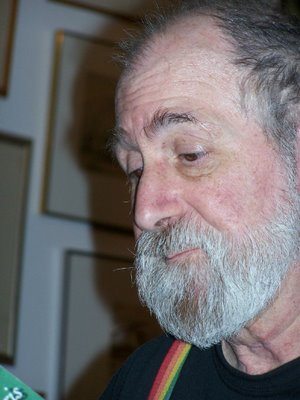
Marc D. Goldfinger

The Water Knife by Paolo Bacigalupi

This book is about the water. Imagine the United States fragmented. Texas has fallen away and there is a fence, much like the one we put up to block immigrants now from Mexico.

Angel is what they call “A Water Knife”. He does the dirty work for the power brokers all fighting for the water rights to what is left of the Colorado River. Angel was hired by a woman named Catherine Case. She found him in a jail but under a false name, which, to all intents and purposes, made him a ghost.

Catherine has a group of “Water Knives” that work for her so she can obtain water rights for Las Vegas. Her nickname is “Queen of the Colorado.”

Angel drives all over Phoenix in his Tesla, an all electric car that actually exists today. Ironically, with gas prices going down right now, sales of the Tesla are a bit off. Americans have short memories and that is what Angel counts on.

Then there is Lucy Monroe, a Pulitzer Prize winning reporter who is closely following the water wars. Somewhere, someone has the papers to the key water rights sold by an Indian tribe in the early 1800’s and they are the only water rights that count.

In shanty-towns around the cities in Nevada, there are pumps where people go to buy water; running water outside the main cities is a thing of the past. Water is more valuable than gold.

Angel and Lucy Monroe catch a relationship on the fly and she saves his life as he saves her. The most powerful cartels are the water cartels and the narcotic cartels. When people lose all the things that we all strive for, there is nothing left but to get high and keep a steady water supply.

But as Angel says, “when things are like this alliances shift like sand. Someone will have to bleed if anyone hopes to drink.”

This is Paolo Bacigalupi’s first totally adult book since The Wind-Up Girl, which is about similar events in Thailand where everything is measured in precious energy units. Night Shade Books put it out in such a small run because they felt it was so complex that it would be a no seller.

But suddenly they were sold out of The Wind-Up Girl and more orders were flowing in. Printing after printing and each printing sold out as the book was Hugo Nominated and Paolo Bacigalupi became a Locus Award winning author.

Soon after the powerful success of The Wind-Up Girl, Paolo Bacigalupi put out two young adult books in rapid succession; one called Ship-Breaker, which was a runaway best seller that won the Michael I. Printz Award and a National Book Award Finalist. His next book was called The Drowned Cities and both books literally flew out of the stores, bought by young adults and older people too.

His next book, The Doubt Factory, was a young adult novel also but all three books sold to adults just as well. Go to www.sparechangenews.net and see my review of The Doubt Factory.

Like The Windup Girl, I predict The Water Knives, will be another award winning power seller. It takes place in the separated United States in the near future.

The main characters, their lives linked by blood and water, are Lucy Monroe, the reporter, Angel, the water knife who works for Catherine Case, and Maria Villarosa, a young refugee from Texas who is always on the edge of disaster.

Paolo Bacigalupi is right on the cusp of Climate Change and is accurate in his vision of the water wars that have already started in the Southwest. He writes about the America that will come about if we continue to be blind to the damage caused by the extreme consumption, taking place in our ‘God Blessed United States of America.’

The city of Phoenix is dying. There are pumps like we see today in gas stations where people line up with their containers to fill with water. Lucy’s sister, back in New England, warned Lucy to come home but Lucy Monroe knows the big story about the water rights is just around the corner.

Lucy Monroe searches for the key to the big story of who owns the water rights as she walks through a morgue over-flowing with the bodies of refugees who fled from Texas. Angel passes the bodies as he flashes his police badge at Lucy, gripping her arm tightly, but when he looks into her eyes, the angel of death grins back at him. Lucy tries to pull away but sees herself in Angel’s eyes as they both look at her friend Jamie Sanderson, who is on a gurney with empty sockets instead of eyes.

Just the other day Jamie, also a reporter, was talking about the key to the Colorado River Compact. Lucy warned him that he was playing out of his league. The morgue is full of bodies, mostly victims of dust and thirst; Jamie has no eyes and is also missing other body parts.

Angel questions Lucy in the overflowing morgue. She looks at his badge, then sees the tattoo of the snake running up his arm. This man is death, thinks Lucy.

“I didn’t get your name,” Angel pressed. And Lucy knows.

Outside, everyone is walking quickly through the dust storm, tightening the dust mask with the REI microfilters. It’s time to go.

Angel screams down the road in his Tesla, soaring like a predatory bird. He knows that the woman reporter in the morgue sees the world like him. Only the water rights bring life.

“Cup or pour? Cup or pour? Cup or pour?” The money is in every drop.

This book, “The Water Knife” will own you. Once you pick it up, you will find it almost impossible to put down. Paolo Bacigalupi has created another masterpiece.

“The Water Knife will be released in Spring of 2015 by Alfred A. Knopf, Publisher, New York. www.aaknopf.com
Frankenstein In Central Square (Conclusion)


Ar Lain Ta tapped his shoulder. Moshe Dean’s head snapped up and he opened his eyes.
“I was paying attention,” was what he said. “I was just thinking about something else,” he said as he wiped the soup casually from his forehead and ground a soft potato into his thinning hair.
Suddenly a car alarm was blaring. A bevy of horns screeched through the open front door. Again Ar Lain Ta said,
“Listen!”
The sound of engines. The smell of exhaust. Seven cell-phones start ringing simultaneously. No one besides the trio seems to notice. The music is blaring. It is a song sung by Jimi Hendrix called All Along The Watchtower. Moshe Dean’s head drops slowly back into the potato-leek soup.
Someone screams into their cell-phone. They have a computer on the other end. It says, “Your call is very important to us. We thank you for your patience.” He has heard it say this for over 19 minutes now. Four others get up from their tables and start pacing wildly about. Everyone is colliding with each other, spilling coffee all over the rug.
Outside, all the traffic lights are malfunctioning now. Seven SUV’s are blocking the Prospect Street intersection. No one will give up the right of way. Trucks and cars are double-parked in the bicycle lanes. One man pulls a large Jeep into the handicapped parking space in front of the Fleet Bank. He exits his vehicle and runs into the bank. The line inside circles around seven times.
Everything is gridlocked now. People are fighting in the streets. Two police run from their car, blue lights flashing and shoot a homeless man to death as he pulls a deposit bottle from a trash can. They shoot him fourteen times. One of the officers turns to the crowd that is gathering and says, “Did you see that? He was pulling a gun out of the barrel.”
People barricade themselves behind the metal tables at the Au Bon Pain as the gunfire intensifies. Sirens are heard in the distance. They are fading away.
President Bush is speaking at U Mass Boston and thousands of police converge on the University Grounds. Any student that moves is immediately shot. The buildings hermetically seal themselves and it is only at this point that the President begins to speak.
“Oil.” he says. “Nuclear power.” he says. He turns to the students in the crowd. “Drink this and forget.” he says as he hoists a bottle of Southern Comfort high into the air. Some of the students turn their backs on him. He looks over at a line of riot police, masked with Kevlar shields, electric batons, and shotguns loaded with toxically-coated pellets.
“Shoot them in the back,” he says. “You’ll be acquitted later.” There is a fusillade of gunfire. Then silence.
There is the sound of fingers snapping. Time flickers and everything is undone. Rogue is holding her hand high in the air. The coffee shop has returned to “normal.”
“You see what we can do,” Ar Lain Ta says but his face is grim.
“You see what we can do,” says the Rogue. She is smiling but there is sweat staining her forehead.
Frankenstein smacks Ar Lain Ta with his massive hand. The eye patch falls off and a swarm of flies disperse out of his eye socket, change in mid-air into maggots and fall writhing to the floor of the coffee shop. Rogue snaps her fingers softly and they turn to miniature Monarch butterflies and disappear out the back door of the 1369.
“You’ll be back,” snarls Ar Lain Ta to the Frankenstein. “The monkey is never dead. It just sleeps and waits.”
Then he disappears. The smell of ancient opium dens lingers in the shop for a moment.
The bathroom door opens and the Troll rolls out. He looks around. Moshe Dean’s head is still in the soup.
“Did I miss anything?” the Troll asks.
Moshe Dean slowly lifts his head and says, “Nah. Nothing happened.”
The Rogue and Frankenstein smile at each other.
Rogue asks a question. “Did you guys ever think of quitting heroin?”
Moshe Dean and the Troll look at each other.
In unison they reply. “Oh yeah. How about tomorrow?”
Frankenstein turns to the Rogue. “I understand. They’re just not ready yet.” And then he starts to laugh. His laughter fills the coffee house and Rogue snaps her fingers once more. A flash of light.
Moshe Dean slowly drops his head into his soup. The Troll turns to him and says, “You know, nothing ever happens around here.”

Frankenstein In Central Square (Part Five)


When the wind blows like dragon-song in her ears Rogue knows she is suspended in time. At times like this she thinks of her mother. She remembers her first awareness of being in the womb. The knowledge of her mission.
And she opens her mouth, howling into the wind of the void, the place of stars and darkness. Then, with the same pain of passage she experienced in the birth canal she spills herself out into the bathroom of the 1369 Coffee House where the Frankenstein is emptying 20 bags of the Bat, the strongest heroin in the Boston area, into his blackened cooker. The monster is crying.
He turns as he senses the intrusion. A beautiful young woman with massive thumbs on each hand is uncurling her body as he watches. Her eyes peer directly into his. They are wet also, a dark brown coloured iris. The Frankenstein is falling, dropping into her eyes. She reaches out and rests her hand on his arm and sorrow, a yearning, a great remorse spills out of her into him. He is stunned by the intensity of it and stares at her in wonder. Her affliction is at least equal to his own.
The Rogue tugs the Frankenstein gently into her arms. The creature feels himself falling, falling towards white space. His head is spinning. His heart trip-hammers in his chest and then, suddenly, he feels a great peace permeate his entire being. It takes a minute for him to realize he is crying.
“What have you done to me?” the Frankenstein asks.
Rogue smiles. “I opened you up to the other place. The place inside you, but outside you. I cleared your cord. Your human creators could do many things when they made you, but they never were able to do this.”
“Christ, I’m not even dope-sick anymore.”
Rogue threw her head back as she exploded with laughter.
“Ssshhh,” she said as she touched his lips with her finger. “No one is supposed to know who I am.”
At that moment the air in the bathroom of the 1369 Coffee House turned grey, the smell of ash filled the air, and Ar Lain Ta stepped through the closed door. His aura bathed them in the stench of ancient opium dens, the petals of poppies fell about them, and the sound of wind chimes rang in the distance in a way that made time begin to flicker.
Rogue snapped her fingers once, then twice. The flickering ceased, the smell of opium remained.
“You can change some things Rogue,” said Ar Lain Ta, “but not all things.”
The Frankenstein stepped toward the smaller man and lightning flashed out from under the Oriental’s eye patch. Ar Lain Ta grinned and the diamonds in his teeth began to flash.
“No, not now gentle creature,” Rogue said as she touched the Frankenstein. “Then he wins. His victory shall not come today.”
“But it will come,” Ar Lain Ta hissed. “Even the fact that you do not do what you were created for plays into my hands.”
“Never mind what I was made for,” snapped the Rogue. “There are some things even the Gods fail to take into account. I’m a product of the limitless, selfless love of one man for a woman.* * When the Eumenides arrived at the scene of the accident — well, who knew?”
Frankenstein watched the exchange. Suddenly he realized he had twenty bags of junk in the cooker. He picked up the cooker and turned it upside down over the toilet and then broke his needle and syringe into small pieces.
“No more,” he said as he stared at Ar Lain Ta. Then he turned to the Rogue and said, “Thank you for releasing me from bondage.”
Ar Lain Ta sneered. “You’ll be back, you forlorn creature. All this time you’ve yearned for death. Heroin brings you closer to death than anything.”
“I have one more card in my thumb,” said the Rogue to the Frankenstein, and she poised her hand to snap once more.
“Wait,” said Ar Lain Ta, “I have one more thing to say.”
“Shall we indulge the Imp of Plants,” Rogue said as she turned to the monster, “and hear him out before we leave?”
Frankenstein smiled warmly at the Rogue and nodded his head.
“Listen,” was what Ar Lain Ta said.
A sudden wind blew open the bathroom door. Outside the door the Troll sat in his wheelchair, a curled grin on his face, his one good eye beaming, a tiny bit of spittle running down his grizzly chin.
“I wondered what was taking so long,” whispered the Troll. His voice resembled the sound of stones running down a red-dirt mountainside. “You aren’t the only ones in the world that need to shoot a little umbrella into their receding veins. It’s always raining out here.”
As the trio left the bathroom and the Troll rolled in, they all noticed Moshe Dean. His forehead was resting in his potato-leek soup. His sparse hair floated on top of the liquid in the bowl.

Frankenstein In Central Square (Part Four)


Frankenstein yearns for a shot of heroin. He wants to stop thinking just for a few hours. An eternity of thoughtlessness would be even better, he thinks, and he makes a croaking sound. This is the way he laughs.
A dwarf with an overly large head scurries past him and disappears into the coffeehouse. Sirens scream, the sound of engines is deafening, second-hand exhaust fouls his nostrils as the monster moves down the walk past the Pill Hardware store. He stands in front of the 1369.
He peers inside. There are four clocks on the wall but he is trapped in a box of space and time. The aisle between the tables is extremely narrow. As he opens the door the dwarf pushes past him on the way out. Ar Lain Ta stands in front of a cluttered bulletin board counting a handful of bills. He sees the creature and grins. The Asian has a small diamond embedded in each of his front teeth. They flash. His fingernails are so long they begin to curl.
“Ahhh,” one monster says to another as Ar Lain Ta counts the crumpled leaves of U.S. currency. Leaves in season.
A few people look up as the Frankenstein enters. Their eyes flick about then they turn back to their computers, their coffee & conversation, back to their innermost thoughts.
The Frankenstein says, “You better have enough for me.”
“There will never be enough for you,” replies Ar Lain Ta, and he throws his head back as his body shudders with laughter.
“You,” the creature snarls as he reaches out for the neck of the smaller oriental man.
Ar Lain Ta pulls back quickly, sparks shoot from his eye. “Just a joke big man.” is what he says.
“The only joke in my world,” says the Frankenstein, “is the reality of existence. I have enough money to buy all the heroin you have. Money means nothing. Dope will get me through times of no money better than money will get me through times of no dope.
“Ar Lain Ta, you one-eyed demon, you were right. There will never be enough heroin for me. When I first came to be, when I first sensed the world it was warm, the leaves rustled as music in my ears and the birds, the birds sang! This was everything to my resurrected senses. Had I known then what I have come to know, I should have screamed to all the impotent gods to kill me.
“I traveled to the North to seek my death in fire and ice. G-d itself would not have me. I have been driven by cursed existence to hide in the dimmest dirty streets amongst the homeless, people driven out of civilization by the lack of compassion, by the coldness of the human species. No Arctic fury can compare to a world which diminishes love.
“I, who can master any man, am the master of nothingness. Ugly, lonely and cold from lack of love alone. I seek the illusory balm of the opiates because even God turns me away from death. Like the homeless man, there are no doorways for me to enter.”
“Come to the back of the coffeehouse,” says Ar Lain Ta to the monster. “The Troll has a table reserved for us.”
As they shuffle down the narrow aisle, Ar Lain Ta passes Frankenstein a bundle of packets with a bat stamped upon each bag.

* * *

The Rogue races down Mass Avenue. She feels a sense of urgency, looks at all the people sitting at tables in front of the Au Bon Pain in Harvard Square. She knows none of them see anything, snaps her fingers and she is opening the door of the 1369 in Central Square.
She sees a giant figure dragging its left leg as it disappears by itself into the bathroom at the back of the coffeehouse. Ar Lain Ta spots her instantly and knows why she is there. Puffs of smoke fly from underneath his eye patch and his right eye burns like a star. He stands in the aisle to block her.
Fear crackles through her like the lines from a struck safety glass window. The Rogue sees the bathroom door closing behind the creature. She smiles at her terror, asks her Father for help, and then she snaps her fingers.

Frankenstein In Central Square (Part Three)


(Rogue created by Don DiVecchio in “The Zen of Fingersnapping”)

She runs so fast. Her brown shimmering hair sprays its kinks out behind her in the wake of her own wind.
Rogue has never felt so late before. Time slips away. She thinks, it is almost too late. And then she breaks out in laughter and the bubbles of it tickle her cheeks as she runs into it.
All I have to do is snap my fingers, she thinks, and I will be there. Why am I running?
Sometimes she forgets who she is, what she can do. She always tries to forget what she was created to do. She just changed her mind. Who could fault her for that?

* * *

Ar Lain Ta sits with the Troll and Moshe Dean. His right eye is glowing, small wisps of smoke drift out from underneath the patch over the socket where his other eye was. He tells one of his many stories while Moshe Dean, with his eyes closed, sinks his thumb into his coffee. The Troll appears attentive, yet one never knows.
“The grasshoppers in Montana have arrived at an invincible strategy to employ against their predators,” says Ar Lain Ta. He grins. “They eat wafer-ash leaves and, when attacked by the anole lizards that would feed on them, they vomit all over themselves. When the anole lizard tastes their vile effluent, they spit the grasshoppers out whole.”
Ar Lain Ta laughs. “Isn’t that a novel self-defense? Military applications of this strategy hardly seem likely, eh? Unless the military were to take junkies and use them as — ah, ha ha, I don’t think so.
“Eh Troll, what do you think?”
“I don’t like to think. The substance of my mind is distressing,” replies the Troll.

“Moshe Dean, how about you? What do you think?”
Moshe Dean opens his eyes to bare slits, sees that his thumb is in his coffee. He pulls it out casually, looks around the cafe, takes a sip of his coffee and then closes his eyes again. His head sags down towards the table.
Ar Lain Ta laughs. “Watch this,” he says, pointing at Moshe Dean.
“Moshe, I have the new batch of dope. They call it Bacardi and it’s better than the Butter. Want a bag?”
Moshe’s head picks right up, his eyes pop open. The Troll and Ar Lain Ta burst out laughing.

* * *

The black man with multiple sclerosis eating his muscles at a faster and faster rate leans on his metal crutches and shakes his cup. Then he stops all movement when the creature limps by. Step, drag.
Their eyes lock.
Misery, isolation, hopelessness, the sickness pours from the monstrous being’s eyes. The crippled black man who is called Donald reaches a hand out slowly and places it on the creature’s arm. The Frankenstein stops.
“Is there anything I can do?” The beggar’s voice cuts into the hazardous waste of the soul of the beast. The Rorshach knots of pain on the Frankenstein’s face cease movement for the first time in decades.
“You,” a guttural growl spills out of the twisted throat, ” you do not recoil from the horror I am?”
“Your eyes. Your eyes are like the ones I see in the mirror when I care to look.” The black man speaks in a whisper, his throat torn by miles of tobacco smoke, his larynx as scarred as Frankenstein’s face.
Tears rise, blow out of the monster’s eyes as if driven by a hurricane wind, splatter on Donald’s face. The explosion of tears chases the knots of pain from the face of the creature.
“There is nothing anyone can do,” the creature replies. “Even G-d cannot touch me for I was built by a man, created in a dark laboratory on a black night.”
Donald looks directly into the monster’s tears. “Today is your day. She is coming just for you.”
“Who?” the Frankenstein asks. “What are you talking about?”
Donald turns away from the grotesque giant and begins shaking his cup rhythmically. He grins. Someone places a ten dollar bill in his cup, almost bumps into the Frankenstein, moves around him as if he were nothing but a tree standing in the center of the sidewalk.
The creature remains still for a junkie’s moment, then he moves away. He thinks he saw Ar Lain Ta enter the 1369 coffee shop a few moments ago. He looks back at the crippled beggar and knows something is wrong in the world when men who so obviously need help have to beg for it.

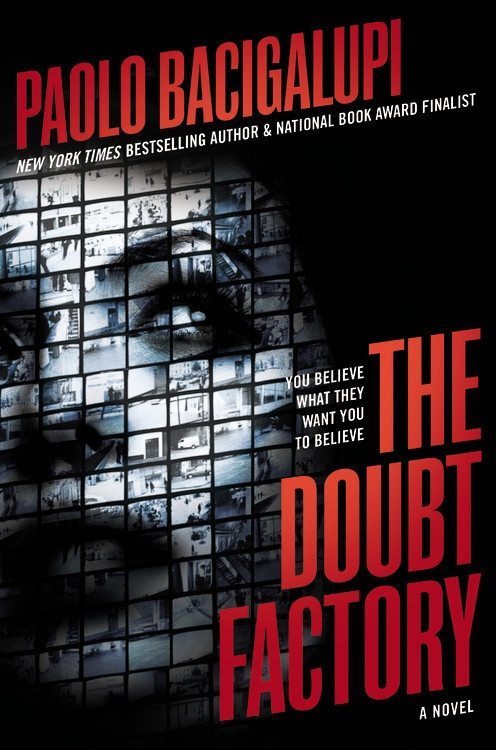
The Doubt Factory by Paolo Bacigalupi

The Doubt Factory is advertised as a book for Young Adults. Not only is it for young adults, but anyone who can comprehend corporate cover-ups to make money will absolutely be enthralled by this tense thriller.

Alix and Jonah Banks attend a private school named Seitz Academy for two reasons. First of all, they were both very intelligent. Secondly, their father, Simon Banks, runs a company that works for major corporations.

When a corporation creates a medication that works for asthma, but has significant side effect on a certain percentage of people, potentially fatal side-effect, Simon’s job is to go to court and create a smoke-screen of doubt that will let the product run on the market for an extra three years.

True, people will die, but in those three years the company will make millions of dollars, much more than they will have to pay out to the families that are affected by losing loved ones to the side effects.

Alix Banks has no idea what her father does. She only knows that he appears to be a good father and provides very well for his family. Much like the lawyers that worked for the cigarette companies and created a thirty year window of doubt before the killing machine was exposed.

There is a young man named Moses who watched his father die in the bathroom because of a drug that was extended by BSP, the company run by Simon Banks, for that extra lethal three years. What if a group of young people who were negatively affected by all the drugs that were protected by smoke-screens joined together with a set of skills that could, potentially if things went well, expose the smoke-screen—show the inner workings of The Doubt Factory?

Imagine if Alix Banks, an intelligent young woman with a code of morality, found out what her father really did for a living? Where would her loyalties lie?

The Doubt Factory is intricately put together and the characters in the book are people that we all can relate to, even the ones who work for security—we can relate to them in a negative way, can’t we?

When I started reading this book I was gripped right from the very start. Paolo Bacigalupi is an amazing writer. His young adult novel, Ship Breaker, was a Michael L. Printz Award winner, a National Book Award Finalist, and a Locus Award winner.

Paolo Bacigalupi’s first adult novel, The Windup Girl, was named by Time Magazine as one of the ten best novels of 2009 and won the Hugo, Nebula, Locus, Compton Crook, and John W. Campbell Memorial Awards. Bacigalupi is a master at creating dystopian worlds, which he did in Ship Breaker, The Drowned Cities and The Windup Girl.

Paolo put together a book of short stories called Pump Six and Other Stories which was a 2008 Locus Award winner for Best Collection. Pump Six was also named one of the Best Books of the Year by Publisher’s Weekly.

This amazing author brings all his skills together in a fantastic roller coaster ride in his book The Doubt Factory, with twists and turns throughout the story. There were times when I was holding my breath as the deadly security team hired by Simon Banks company was closing in on this group of young people gathered together to expose a group of CEO’s of drug companies responsible for the deaths and the crippling of individuals who had taken their drugs.

The Doubt Factory will be released by Little, Brown & Company in October of this year, and it is a book that should not be missed by anyone and made mandatory reading in all high schools. Paolo Bacigalupi is a genius and one hell of a story teller.

Even though I’ve read it, I’m buying my hard cover copy, already paid for, at the Harvard Book Store in Cambridge.

Frankenstein In Central Square (Part One & Two)


They call me the Troll. I’m sitting here in the 1369 Coffee House on Mass Ave in Central Square. My guts feel a bit ropey. I ran out of junk a few hours ago and sent Moshe Dean out to find Ar Lain Ta. I’m so down that I’m contemplating rolling across the street and going into the Can Tab Lounge for a drink.

That’s real depression. I hate the alcohol buzz so much that when I think of drinking, what it really means is that I am suicidal. In the dark.

When the dark comes it can come so quick that it takes your breath away. Which is the whole objective around what comes next. When it comes like that I really want to get some good dope.

Very good dope. Maybe some junk that will kick in the dreaming dark.

Overdose. If I’m lucky, but how many junkies are really lucky, over the news there will be a warning, a public announcement of sorts. It will say “In South Boston today four heroin addicts were found dead, the needle still inserted in their arms. 19 other heroin addicts were treated at various local hospitals for overdose. Reports are still coming in. All addicts are warned not to buy or shoot the bag stamped with the name “Butter” due to the lethal nature of its contents. It is estimated to be close to 90% pure.”

Which translates — to any serious junkie (and what junkie isn’t) — go get it boys and girls, it’s the best shit in town.

And we do.

Like grease on a mission we slither out of the crashpads, the suburban candy-lands where we live with our denial-coated parents who sit glued to the tv (maybe they’re both at aerobics class), from the luxury apartments paid for by trust-funds or our dotty.com companies. Maybe we leave our wives(husbands) or boyfriends(girlfriends to sell the coke or weed that pays for our dope habits. We creep out of our SRO’s, those cockroach-laden hideaways made possible by twinkle-toothed slumlords, the wet and dry shelters, the Salvation Army (maybe we need a fix just to get through their God-awful religion classes that they jam down our bile-coated throats as the price of a cot and a hot), and all the other castle-keeps we stay in — and like a skulk of foxes we skitter into South Boston looking for the final fix.

The overdose. It can come gentle, just a greying around the edges of the picture frame of reality, a closing circle of grey just like the cheap fade-out of a grade D celluloid made for the loops in a handjob saloon disguised with the name — Smitty’s Adult Movies, Books, and Toys XXXX.

Maybe you press the plunger down on the overused disposable (designed for one use then throwaway) (instead we are the throwaways, the unwanted children, the homeless, PTSD-Schizo-Bipolar-ADD-Sad beyond depression-Can’t fit in anywhere-Can fit in but who wants to-you fit the category, we’ll fill it) we were pressing the plunger down — the barrel of the syringe is filled with the killer dope and you (we) feel the hoof of a powerful hors thump you (us) in the chest and then — the lights go out.

Maybe the scenario is like this: you (we) feel so good, the rush is coming on right now. We pull a cigarette out of the pack, put a flame to the end of it and think — as you suck the smoke in to your blackened lungs — wow. For a change I got a decent bag, maybe my luck (hard luck junkie) is changing, you say to yourself(no one else is listening anyway). You (I mean you) take a drag and as we (all together now) slip the belt off our arm, our knees begin to bend, then buckle and we fall to the floor like a boned bag of water. The cigarette is still burning. It is still between the fingers. If we were still conscious we (you) might feel it blistering the skin.

On the floor now. Shallow breathing, maybe our eyes are open (no lights on). A short time ago we scored a burger from McDonalds and now we aspirate it into our mouths, take another shallow breath and suck the burger (McDonald’s finest) into our windpipe.

Maybe things aren’t going this well for you. For a junkie there are always glitches. Like maybe someone called 911 and they are shooting you up with Narcane. Instant withdrawal. Ugh.

I don’t want to even think about that. Let’s chat about something pleasant. Oh, here comes Reverend Love. “Want a coffee?

Cream, no sugar, right?”

He sits down. I ask him, “What’s up?”

He says, “Get a camera.” Then he picks up his coffee, rises from the seat, and walks away with a smile on his face.

Suddenly the back door opens and Moshe Dean slips in. He hands me two packets stamped “Butter.” Then he says, “That’s all for now. Ar Lain Ta is coming here with the rest.”

I wonder why Ar Lain Ta is coming as I roll into the ladies room to shoot up. As I close the door I see Moshe Dean enter the men’s room. Little did I know that I was soon to meet one of the most misunderstood men of all time.

At the same moment the needle chased my fleeing vein to a showdown on the Erie railroad running down my forearm the monster was crossing the Charles River on a train.

Not a one of us, me, Moshe Dean, Ar Lain Ta, nor the monster knew what was in store for us on this fateful day. But the Rogue — ah, but we’ll get to that, won’t we?

Frankenstein stared out at the Charles River as the Red Line train headed toward Cambridge. With the exception of his left leg his entire body was wracked with pain. It was a sad fact of old age. Unfortunately, there would be no permanent relief brought about by death. God had no control over him. He was a built better product, made to last forever by a madman.

He knew Ar Lain Ta was heading towards the 1369 Coffee House in Central Square. Only the soothing balm of the opiates stilled the stabbing pains that circulated through his scarred body. Frankenstein scratched the scar looping around his neck in the area just below his Adam’s apple.

The old woman sitting across from him, the one clutching her tattered shopping bag stared openly at him. This was not unusual. He was 6′ 5″ on a good day. On the bad ones he was much shorter. Knots of pain whorled his face, appearing to move about, shifting from his cheek to his chin, down to his neck just above the jagged scar he scratched, then up again. At least three of these dark Rorschach blots moved across his facial area at any given time; usually there were as many as five.

At times, during the summer, Frankenstein would take off his shirt and make his way along the asphalt parkway by the Charles, dragging his left leg in an eerie shuffle. People would move away from him quickly, either averting their eyes or staring boorishly at the horrid movement taking place across his back and chest area.

Lines where he had been connected together crisscrossed his body. The tattoo of a demon with the horns of a bull, one eye located in the center of its forehead and a twisted mouth that leaked red droplets of blood with the body of what appeared to be a small headless dog in its hand was the final insult visually hurled at anyone who looked.

Needless to say, with all this to look at one might never notice the needlemarks above the veins on both his arms.

His grotesque body which, unfortunately for Frankenstein, housed a mind possessed of a unique romantic, an idealistic poet and philospher which could not help to realize how alienated and separate from the rest of the world he was had, from nine decades of constant opiate consumption worked itself up into a “jones” which, were it to leap from his body all of a sudden and take the shape of a monkey it could pluck King Kong from the side of the Empire State Building like that great ape was a toy. In other words, old Frankenstein was one strung-out dude.

The train halted and the computer voice, with a proper mid-western accent, announced, “Central Square.”

Frankenstein rose and lurched toward the open door, praying that the escalator was still working. He didn’t know if he could handle the stench of urine in the elevator. He pushed through the turnstile. At least, he thought, I don’t stand out in Central Square. There are so many monsters here that I am just one more freak in the show.

The hum of the escalator was music to his cauliflower ears.

The Troll sat at the table with one eye closed. He watched Moshe Dean’s head bob up and down like a flower in a gentle wind. The smell of a million opium poppies whacked his gnarled nose and he turned his head as Ar Lain Ta slipped in the front door of the coffee house. No one else was aware of his entrance except for two other junkies, a man and a woman who sat midway against the wall. Both of them, once devout Catholics, made the sign of the cross.

Ar Lain Ta nodded to the Troll. The Troll nodded back.

At this moment, outside on the street, the Frankenstein was dragging his left leg past the Spare Change vendor in front of the Fleet Bank. The vendor fell silent as the creature passed him. Their eyes met. Both of them simultaneously nodded to each other, a gesture of respect, acknowledging the fact they were both related. Two dark holes in close proximity to each other in the infinite night.

Poison Pen

No Apologies

This is a book of poetry written while I was in prison in 1982—’83. Although my writing style has changed much and I felt a compulsive need to alter many of these poems as I typed them in for this collection, I resisted. The reason for this is simple. Poison Pen is a reflection of where I was during the years this was written. To be true to myself, to what I was, whether pretty or ugly in the mirror of these times, deep in the passion of my addiction to heroin, I present myself as I was. In the world of poetry there may be many who find fault with my style back then. To these poets, I say that Poison Pen is my truth. It is my testament to the inferno from which I emerged scathed.

There are those who might say some of these poems are politically incorrect. If you are one of those people, I suggest you get into a time machine, travel back to 1982 and ask to be let into Maximum Security at the prison and confront me there.

We’ll talk it over.

I have no apologies for what I was. It was my path at the time.

I have no apologies for what I am today.

Written in Salem, Massachusetts in what they call a sober house. 18 September 1999.

Free Love
You can love me
the way I am
You can leave me
the way I am
I’m not changing for you
I’m just changing.

Written in West Boylston, MA in what they call a house of correction from 1982—’83 by Marc D. Goldfinger

poisondetail

Visiting Hour

Almost visiting hour.
I wait.
Hoping —
As they call
Numbers.
No names here.

Numbers.
Numbers.

I had a name
Once,
A long time ago.
I was free
Once,
A long time ago.
I knew laughter
Once,
A long time ago.
I saw you
Once,
A long time ago.

They call numbers,
But not mine.
No number.
No name.
No visit.
I can’t laugh in the mist.

by Marc. D. Goldfinger from his e-book Poison Pen.

Marc. D. Goldfinger. Poison Pen. 101 pages, e-book at Metropolis

The Love of Nadia Chance


It begins again. The voices of the women singing in the background as the morphine kicks in. I can feel the first wave now. The Troll is in the kitchen with Ron de Veux and there is a knock at the door of his subterranean apartment.

The evening has been particularly disturbing. I have been nursing the last few milligrams of the drug and have not been able to drown out the piercing cries of the tenants above me. In between the cries I hear the frantic fluttering of wings. Angels. The other junkies believe the Troll when he says they are angels. I’m not quite sure but the fluttering of the wings always gets to me. I can hear those wings even in the deepest junk nod.

I answer the door and it is Nadia Chance. She kisses me on the lips, her breath is musky and heavy reeking of promises kept and hearts broken. She holds up her hand and there is a vial in it.

Samuel, the pharmacist who is totally taken by her, is her supplier of morphine. The price of hot whispers and a burning mouth that makes him wake shuddering in the night is one-hundred tablets of 15mg morphine, three times a week. One day it will cost him his license and his frigid wife. Then Nadia’s mouth will cool, his store will close and his wife will sue him for what is left. Instead of sucking on Nadia’s open places he will place his double-shot .38 into his mouth and spray the bathroom wall with blood and brains. But this is yet to come.

One night, during yen sleep, before Nadia had even met Samuel, the Troll had one of his dreams. When he awoke he asked Nadia to go to the pharmacy on the corner of 88th Street and Broadway. She had asked why she was to do this and the Troll just smiled and said

“Hurry. Just go.”

And she did. Four hours later she returned with pinned eyes and a bottle of morphine tablets, enough to fix every junkie in the apartment. After we had all fixed the Troll spun the tale of Samuel and Nadia. At the close of the story, when Samuel lay dead in the blood spattered bathroom, the Troll admitted that it was only a dream.

After hearing the tale Nadia went out walking the streets of the city and did not return until the sun was rising. She immediately swallowed three tabs and shot two of them. Then she made coffee and stared at the basement window for a few hours. All the basement windows are curtained and beneath the curtains the glass has been painted black.

She has been seeing Samuel regularly for seven months.

My hand shakes with sickness as I try to fix and Nadia reaches over and gently takes the hypodermic from my hand. I hold the belt tight around my arm and she places the needle directly over the scab from my last shot and taps it in. Blood spot at the bottom. She nudges the plunger back and my red life flows into the barrel. Slowly she slips the plunger to the bottom of the syringe and I disappear into myself.

I look up at her as she kisses my forehead.

There is a knock at the door.

I function as the gatekeeper and open the door. Sunken eyes are the first thing I see, dark with night that seeps into my own and I feel the tears rush to the back of my eyewall. He has a forehead with cavernous furrows yet his cheeks are smooth and appear to have no hair at all on them. His lips are soft and inviting and look ever-so-kissed. Above his lip, just below his nose, the normal ridges of the upper lip are absent, just a smooth track from one side of his mouth to the other.

I recall a tale that my mother told me. It was an old fable about the child in the womb. She said that we, as unborn, contain all the knowledge of our past and future lives within us as we rock in the sea of salt, the ocean of time connecting us to all things inside our mother. Then, in the few moments before we are born, an angel visits us in the womb, whispers into our ears and then says, “sshhh” as it presses a finger of heat onto our upper lip below the nose. We forget everything with that touch but the impression of that finger never leaves us. That is why we all have the indentation on our upper lip. It is the fingerprint of an angel of mercy. We are born clear, more pure than freshly falling snow.

Never before in my life had I seen anyone without that indent on the lip.

“May I come in and sit? I just need to talk to someone.”

I hadn’t realized that Nadia was with me at the door. She reaches out and takes his hand. He almost smiles as she guides him in to a small table surrounded by chairs in one corner of the great room.

“Sit. All are welcome here. Can I offer you something to wash the weight from your spirit?”

“No thank you. I don’t believe that you have anything strong enough to do that here.”

Nadia sits down near him but does not respond. I sit in another chair by the table but move it back slightly into the shadow. A candle is burning on the table and the wax spills over onto the dark whorled wood. There are many cigarette burns on the table. There is also a ceramic ash tray with four small hands, one on each corner holding it up, and a map of the world intricately painted as if the world was flat in the center of it with the oceans spilling out onto the cigarette rests. It sits embedded in old wax.

The man is wearing a heavy dark raincoat made out of a cloth of some type and I notice that his back is slightly hunched beneath the coat. The illusion that this creates makes it seem as if his shoulders were rising above themselves.

As Nadia crosses her legs the skirt she is wearing slips open slightly. He does not seem to notice and begins speaking again.

“I am waiting for my father. He will come very soon and then I will be gone.”

“Has it been a long time since you’ve seen him?” asked Nadia.

He almost smiles again. “Yes, quite some time. If I did not know how this meeting would go, it would be better for me. My conversation with you was the only thing that was unclear. I knew that it would take place but the content of it was a mystery to me.”

I want to ask how he knew how the meeting with his father would go but it is as if my lips had a seal upon them and cannot open. I realize that I am only there to observe and record these events in my memory so they might be written at some future time.

At that moment Nadia chuckled and put her face very close to his. He did not move away and his nostrils flared out and he breathed in deeply.

“Your scent is startlingly pleasant. I remember it in my dreams when I can sleep.”

“You like the way I smell,” said Nadia and it was not a question.

Then she rises slowly and takes his hand. I watch them walk together to the back room and close the door. Alone again, I take out two tabs of morphine and fix. My hand does not shake this time. After rinsing the hype I let it rest in the glass of water and my eyelids drop over my eyes. The dreams come.

And go.

Someone taps my shoulder. Nadia.

“He is sleeping,” she says. And then she tells me his story.

I don’t know how long I listened, how long she spoke, but afterwards I felt very tired, as if I had been awake for days, and very sad, as if someone very close to me was about to die.

Then he, she called him Simon, walked back into the room, shrugging his coat over what looked like a pair of large grey wings.

Simon placed his hands on her shoulders and spoke.

“There is nothing I can do for Samuel. I will look after him when he comes to us. The child will not be his. It will be from us, from tonight. My father does not know everything for I did not know what was to take place here. You are a good woman. One day you will leave here and your name will be different. I cannot tell you when or how this will come to pass for it would change everything.”

Nadia cries and the tears run down her cheeks. He takes his finger and catches one of the tears and lifts it to his lips. Then he places his finger on the indentation above her lip and she closes her eyes. She sleeps.

Simon looks at me. Suddenly there is a great wind howling in my ears.

“My father is coming. I am out of time.”

Then he reaches out to touch my lip but I pull back. He pauses, then the furrows in his forehead deepen.

He says, “Memories are made of this.”

The next thing I know is that I am very sick, dope-sick like I was 48 hours without a fix and the wind is just outside the door. I hear the door open; I hear it close.

I reach for my stash. My hands are shaking. Nadia will not help me this time. I let her sleep.

A door opens behind me and the Troll and Ron de Veux come out of the kitchen. I am fixing. Ron scratches her crotch and the Troll wipes some spittle from his chin and asks,

“Did a storm pass this way?”

I nod.

“I thought so,” said the Troll.