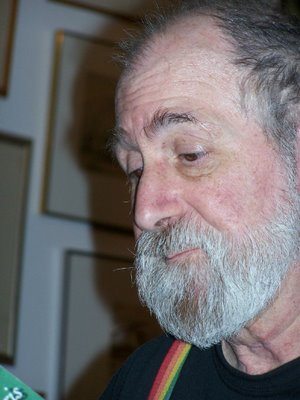
Marc D. Goldfinger

Obama, The New President

Now the work begins, undoing all the damage that the Bush presidency has done. Hopefully, all the soldiers will be brought home from Iraq.

The fact is, this is more than Barack Obamas job to remake the vision of our country. It is our job too.

Under the regime of Bush & Cheney, we have again become The Ugly American. Barack Obama inspires hope in me and I know that I have to do my part.

Use less fuel. I bicycle, I have a small motorcycle that gets 60 mpg, a Honda Rebel 250cc, and a nine year old Honda Civic that gets close to 30 mpg. My wife has a newer Honda Civic which gets 35 mpg.

And that’s just the beginning. A new beginning for all of us.

Do I pray? Yes, I do. But it takes more than that. My actions speak louder than my words. I can say anything I want here but if I don’t live it, it becomes meaningless blather.

May the world, and the United States, heal, heal, heal.

Our species stands poised on the edge. We face challenges never faced before. The choice is ours — the collapse of civilization as we know it — or a world where life is held sacred and promises kept.

May whatever God you believe in calm your spirit and enrich your soul.

Love, Lies, and Broken Dreams (Conclusion)

Jeanie nods her head as the tears spill down her cheeks. We huddle together on the mattress, both of us crying, until we fall asleep. We sleep for 30 hours.

When we wake up I go over to the office of the trailer park and they offer to buy the trailer back for much less than we paid for it. Out of desperation I agree. It will take a week for the deal to clear. Our checks are due on the same day they will pay us. Out of money, out of food, we decide to trap turtles one more time.

The sun is out and the tropical air is like steam. I hammer the stick into the mud by the bank of the canal while Jeanie baits the hook with a chunk of salt pork. She drops it into the water. Two other guys, Archie and Turk, come with us to set traps also. They are experienced and set traps much faster than we do. They bring along a cooler of beer and a few joints which they share. We will split the take tomorrow morning.

All of a sudden we see a Florida State Ranger truck bearing down on us. There are two of them in the truck, big and burley, and they have rifles and handguns. Their truck slows to a stop. They both get out, hands on their guns, and stroll toward us. Eyes like ferrets.

“What’s in the cooler?” one of them asks.

“Just beer,” I reply.

He walks over and opens the cooler, paws through it.

“Mind if I look through the rest of the truck,” he says, while the other ranger just stands there with his hand on his gun. We know that he is not asking for permission and we motion for him to go ahead.

“Any of you got any drugs?” he says.

“Nope,” I lie, “just beer.” Turk has two joints left in his shirt pocket.

They stand around for a few minutes looking for anything that will demand their attention, check the traps we are putting out, and then they get back in their truck and pull around ours.

“Leave the gators alone,” one of them says as they drive away. “We’ll be back around later.” We hear their laughter above the sound of their truck engine.

Turk, who has always lived around here, says, “You don’t fool around with those guys. We could all just disappear here and no one would know who or why, or care for that matter. Don’t think it hasn’t happened. The canals are spooky. People just vanish. God doesn’t want to know what lives in the canals because he had nothing to do with the making of them.”

The next day we pull our traps. Nine large turtles, two of them massive. One of the smaller turtles is dead. We throw it back into the canal. The fish stands don’t want them if they are dead. The first stand we stop at weighs them and makes us an offer for the batch. Turk whispers to me that it is the best offer we will get today. We take it.

We buy two large bottles of Wild Irish Rose and three cases of beer. We have enough left over for hot dogs on buns. Then we start to drink.

I never was much of a drinker. Jeanie, Turk and Archie start putting them away and two other guys join us with weed. By dark we are all staggered and we decide to go bridge-walking over the canals. There are cement walks about two feet wide that criss-cross over the canals. We stumble over them, a beer in one hand, a joint in the other and finally we find ourselves on the shore of Lake Okeechobee.

When Jeanie and I first moved to Pahokee we had this naive notion that we could go swimming in that great lake. We found out different when the locals laughed at us.

“Sure ya kin, jes’ you two, the gators, the big snappers, the water moccasins, not to mention the things we don’ even know what the hell they is that lives’ in them waters.”

We weren’t tempted to try it out.

We sit with our legs crossed, never dangling, on the cement walks crossing the canals and toss down one beer after another followed by the reefer. Giant bugs fly around us, sounds of birds that we don’t know the names of call out, sounds come from the canal. A chill runs up and down my spine and I shake it off. We all toss wild ideas out into the night and they come back to us bearing strange shapes.

We get up to travel to another area, maybe go back to the trailer park, no one knows where we are going really, no one. Then it happens.

Jeanie vanishes just like that. One second she is there and then gone. There is a splash and she is calling to us. We hear her thrashing about in the dark water but cannot see her. Then we hear the sound of other things splashing into the water. The water ripples towards her and she screams.

There is the sound of feet running away. There is the sound of Jeanie screaming. There is only me and Turk left, leaning over the cement walk, hair spilling into our sweaty faces, arms extended, yelling for Jeanie to take our hands.

Then her hand is in mine, her hand is in Turk’s, we are lifting her out of the water but something is on her, something is thrashing about on her, by her neck. We lift her out as her voice modulates wildly. On the cement walkway we see the shape of the thing with its mouth holding onto her neck. It is biting her throat.

It looks like a small man, or possibly a woman, with fins and scales, eyes flashing blood-red in the moonlight, webbed feet and hands, vampire-teeth withdrawing from her throat as it pirouettes into the air and vanishes beneath the water.

Jeanie closes her eyes and goes limp.

None of us could recall the frenzied walk back to the trailer park, how long it took, how we came to be back there, nothing. None of us could recall the first moment that we noticed that Jeanie’s brunette hair had turned white or that her pupils now filled her eyes with black eating up the blue of her eyes.

When the ambulance came for her Turk and I told them about the creature. The medics looked at each other and muttered something about cocaine psychosis. The doctors examined the bite marks on her neck, referred to
them as the lacerations, whispered to the nurses when they saw the track marks on her arms.

The hospital kept her under observation for two days, then gave her Stelazine and Klonopin and called me to pick her up.

From that night on nothing was the same.

The sale of the trailer went through and we packed our meagre belongings and moved up to Boston. We both knew where we could get heroin in that area.

Jeanie would vanish for days at a time and return with no explanation. She would go days without uttering a word. If I mentioned the creature from the canal she stared off into space. Sometimes she would turn to me and say, “You know he’s coming for you, don’t you?”

When I asked her if she meant the creature she would shake her head, then turn away and cry. If I reached my arms out to her she would sit still like dead wood in my embrace.

Both of us continued to shoot heroin. Our habits reached phenomenal proportions. I began to dream of small villages in the orient where people were raising opium poppies. There was an old woman that was always on the edge of my dreams. At times, in the dreams, I would be wandering homeless through Harvard Square in Cambridge and there would be a man watching me, following me. When I asked him who he was he told me that he was the son of Nang Saeng Zoom and suddenly the old woman would be there, next to him, smiling at me.

One day I came home to our small apartment and Jeanie was gone. There was no note, no explanation. Every mirror in the apartment was shattered. To this day I have no idea what happened to her. I only know that before she left she was already gone. I wonder whether some day, some place, I will turn a corner and she will be there with her white hair and her pitch-black eyes swallowing me up into her night.

There is no sense of time here at the Troll’s basement. For me, it is better that way.

There are only the stories of other junkies like myself that I am here to record. And there are angels on the upper floors. And then there is Ar Lain Ta. He is coming for me, he is coming for us all.

Tonight I know that I am in love with Nadia Chance. Here, in the Troll’s dark basement, the next shot of heroin and the unrequited love of Nadia Chance is all I have. For now, this will be enough.

Paradigm Shift: The Obama Presidency

It is not by chance there are many of us.
It is not by chance we sing to each other.
It is not by chance the Gods let us touch.
It is not by chance, like plug and socket, we fit together.

from A Room of Bone — a poem in Relationships by Marc D. Goldfinger, edited by Ibbetson Street Press, Somerville, MA

George W. Bush has left the stage of the world. It is Barack Obama’s time. Yet as Barack Obama knows well, it is not only his time, but it is also our time. Obama is our president and we are the people. In his speech many of his reflections called upon us to do our part, for he knows that alone and isolated, a president who works against the will of the people cannot work. We have just witnessed eight years of decline, eight years of waning hope, eight years of spending the birthright of our future, eight years of hopelessness, death without purpose, eight years of the heart of a nation breaking into tears of sorrow.

The glory of Barack Obama is that he is truly the heart of the United States, yet he realizes the heart is only a source of inspiration if all the other organs work well. Barack Obama knows that a leader is only as strong as his ideals; that if he doesn’t lead well, the people will not follow.

Barack Obama does not take his new trust lightly. He knows that the world is at a pivotal point as far as the human species is concerned. He is aware that the path we take from this point is crucial, and it takes us all to task. It is our responsibility to work with our new president, to help him achieve his goals and also to speak out to him when we feel that he is going off the path. Because Barack Obama is a president who knows that he has much to learn from those around him. Obama is a president who is humble, who will keep his ears to the ground, his eyes to the sky, his hands on the plow, and he knows that he must not only say what is necessary — he must follow through with his actions.

Sixty years ago, men and women of colour were relegated to the back of the bus; men and women of colour could not drink at the same water fountains as white people; men and women of colour were not free in the United States.

Barack Obama knows that, in just sixty years, there has been a paradigm shift in our country. That is what makes it great. It is not that everyone has changed in sixty years, but enough of us have changed to make this new world possible.

Barack Obama raises the hopes of the people of the United States. But it is not only the people of the United States who have their eyes on this man with “The Audacity of Hope”, it is the people of the world who have their eyes on him because he raises their hopes too. The world is watching him; the world is watching us; the world is waiting and hoping that Obama is what he says he is, and what he has shown us he is to become the president of our land.

I am a cynical man, but I have hope for humanity. It has been a long time since I have been inspired by a leader, and Barack Obama has won my heart. And not only my heart, but the hearts of many, people in the United States and people all over the world.

There was a time, a long while ago, when humanity was given hope. There was a president who said, after Russia launched Sputnick, the first satellite, that we would be the first nation to reach the moon. And God knows, if there is a God and I believe there is one, that we joined together, each in our own way, and in 1969 humanity walked on the moon.

Barack Obama offers us a new challenge. He does not say that we will be the first to walk the moon; Obama says that we will lead the world with fierce love; that we will “offer our hand if you will unclench your fist.” Obama says that “this is the time to put aside childish things.”. I believe he knows that war is the enemy of us all, and those who choose war over life are the ones who delay the new rebirth of the Human Nation.

It is not just the United States that must grow; it is all the nations of the world who must unclench their fists, just as we must join them. Those of us here in the United States with clenched fists must stop, think and open their hands so they can work with us. Barack Obama knows that this is a world where, if anyone is left behind, whether black, yellow, white, poor, rich, red or just average, if anyone is left behind, we will all be left behind.

This is not a time where we must fight and claw to be the first to walk the surface of the moon. This is a time when we must join hands and work together to walk and ride and sail across a clean, peaceful Earth. There is only one way to do this.

Again, I repeat Obama’s words, which he took from the Bible, and those words are that “we must put aside childish things.” This I know to be true — war is one of those childish things we must put aside. As Obama said, “When it was time for us to face the future, we faced it and did not falter.”

Barack Obama is more than the heart of a nation. He can be the heart of the world. Instead of strapping bombs to ourselves and destroying the future, we must strap tool belts around our waists, whatever tools we use to build, and work to turn our backs on the errors of the past.

There was a president who took us to the moon. Let Barack Obama be the president who takes us all home, and let him be the president that inspires us to work so that all people, all over the world, can be safe in a home of their own and walk the world in peace.

Published in Spare Change News, Jan. 29 — Feb. 11th, 2009.

The Accident


I’m not saying that there is no such thing as a solid reality. Really, what I mean by that statement is that all we get to go on is a construct of reality filtered through to us by our nerve systems that have been altered, muddled, and distorted by others since the day we were born.

Which brings me to Cowboy. The man had his own reality but fate cast him into another stranger, more alien reality than he ever dreamed existed. He never travelled farther west than Olean, New York. The only use he had for cows was gathering mushrooms from their pasture pies. As for riding a horse, it was his opinion that the only thing with brains that was born to be ridden was a woman.

Cowboy was born into a drinking family. Motorcycles, alcohol, drugs, and fast women. Riding the iron horse was his life. Everything else came second. His bikes were fast and powerful. When he was drinking he didn’t like to stop for traffic lights because usually he was so loaded that, when the natural balance of the moving motorcycle ceased, he fell down.

When he was young he learned from the men in his family. His sexual practices were Neanderthal in nature to say the least. At the age of nineteen Cowboy thought that foreplay was letting three of his friends have her first while he finished his case of beer.

Sascha changed all that. He met her at a bar in Hillsboro, New Hampshire called Tomachhio’s when he was thirty-one years old. He had just finished drinking a shot of Jack with a beer back when she walked in.

In Italy they say every man and every woman has the perfect partner and when that person walks into their life, it is as if they are struck by a thunderbolt. Cowboy had never heard that story. It didn’t matter. He was struck when she walked in.

In that moment everything changed for both of them. They drank, they danced, they went home with each other.

Two years later the car came out of nowhere.

But let’s back up a little. Sascha pressed her sweet self into Cowboy’s back as they rode. Sometimes she dropped her hands into the wind and just leaned back into the sissy bar as the wind tied her hair into a beauty explosion of crazy knots. On this day she reached around him with both arms, slid her hands under his shirt and stroked him where the forest of his pubic hair began.

Cowboy was heated with her love. Three days ago, it was a Saturday night, he had been out drinking with his cohorts. At 3AM Sunday morning he remembered that he had told Sascha he was coming home directly from work at the flea market in Derry, New Hampshire. He had closed the stand at 5PM with all intentions of heading right home when Sprockett and Toad stopped by. They went out for a beer.

Ten hours later, which was one hell of a lot sooner than the time he had gone out for a beer in January of ‘81 and returned in April of that same year with the explanation that he had lost track of time and didn’t think it was going to take as long as it did to pick up that scooter just over the state line in New York but there were other brothers, bikes, and a small police matter that tied him up for a bit, but here he was only ten hours late and a little drunk so he kicked the front door in, threw his leather on the couch in the living room and walked into the kitchen. Sascha sat at the kitchen table reading a book.

She looked up at him with those eyes that made him dizzier than one fifth of Johnny Walker Black.

“What’s the problem?” he asked.

She smiled. “No problem except for the front door.”

“Well, I had to get in and if you hadn’t locked . . .”

“Cowboy. I stopped locking the door eight months ago. This is the fifth time you’ve kicked it in when all you had to do was turn the doorknob.”

“Wow. I forgot again.”

She smiled. “I’ll put a steak on for you while you put plastic over the opening. I made salad and we have Bleu cheese dressing.”

Cowboy didn’t really know what to say so he went into the living room, closed the fresh air conduit he had opened, and then he went back to the kitchen and sat. He watched Sascha move around the room. He couldn’t take it anymore and went to her.

Afterwards they ate steak and salad. Then they went to bed. Later they went to sleep.

48 hours later the car came out of nowhere.

Cowboy attempted to lay the bike down. It was too close, everything was moving too fast, and it was just too damned late.

When the sound stopped the world lay twisted on asphalt. Cowboy raised himself from the weeds on the side of the road. A car engine roared loudly, then faded as it vanished around the first curve, dipped down over the rise and was gone. Silence.

The first thing he saw was the bent motorcycle. Then he saw her. Sascha lay near the bike, twisted, broken, silent. There was a growing pool of liquid spilling from the cranial area of her body. Splintered bone protruded from her right leg. No movement except for the growing stain under her head. A high pitched whine scraped the air all around him as his black leather boots pounded the dark pitch road. It was not until he reached her side that he realized the sound was coming from his open mouth.

If sound equaled wind, the trees would have been torn from the ground by his cry and every nearby cloud might have been ripped out of the sky leaving black spaces where the blue should have appeared.

Sudden death is darkness like a knife puncturing the illusory veil of light within which our reality dwells. Denial and horror are the children borne of the rapid sweep of the scythe. Cowboy was a tree rooted to the road looking down at his loved one. The summer of his life skipped autumn and roared into winter.

There was no room for rage in his broken heart. He did not think of the murderer who had left the scene. All he could do was drop to his knees, tears cutting his cheeks, soaking his heavy beard, press his hands to the inert body of the one he loved and scream his prayer to the impassive sky.

“No,” he howled, “no, God, take me instead,” was what he said and he meant it with every fibre of his being.

“God, take me instead.”

There was a moment of total black. Even the air smelled like dark earth, worms turning after a flood rain, the scent of myrrh in the midst of it all.

There was the sound of wings beating. A flash of light.

Cowboy rocked back on his heels, almost falling over by the jolt he felt when the bird-like creature with a woman’s head appeared. She was over six feet tall with long flowing thick hair that moved as if it had a life of its own, eyes of rainbow shooting sparks of multi-coloured light. The biker’s dark beard was suddenly shot through with shocks of grey. His tongue grew thick in his mouth and he could not speak.

The wings of this strange creature beat slowly, rhythmically, even as she stood facing Cowboy and casting those unbelieveable eyes down at Sascha.

“Let me see . . .” she said as she placed her hands on the still woman’s chest. “Yes, yes, we can do this,” she muttered and looked up at the sky. The sky. It was filled with colours moving like a sea of unrest, a storm, a typhoon from another world.

Cowboy was rigid. There was no way he could process what was happening.

The winged one pressed her hands onto the quiet chest of the woman.

“Clear!” she spoke and the body of Sascha leaped as if a great electric current sluiced through it. “Again!” spoke the creature and the body of Sascha convulsed again.

This time the winged one was thrust back by the force of the blow. Her wings beat, beat, beat to retain her balance and she did not lose contact with the dead woman.

A great wind came from nowhere and moaned with sorrow. It seemed to come from everywhere and Cowboy looked about for the source of it. When he turned back to look at Sascha, he saw that this wind came from her.

The creature glanced into Cowboy’s eyes, turned the lock.

“I am Alecto of the Eumenides, servants of the greater Gods,” it said. “You called, we came.”

“But what . . .”

“Your life for hers. We salute you. It is true love.” Then the creature that called itself Alecto smiled.

The great wind had become the sound of peaceful breathing and Sascha appeared to be waking up from a great sleep.

“Quickly,” said Alecto. “There is little time.”

“I’m ready,” Cowboy said, and he felt his heart flutter like a little bird in the barrel of his chest as he reached out to take the hand of Alecto.

Alecto threw back her head and laughed, her thick hairs coiling and writhing like serpents, then she spoke.

“Oh, you will be taken,” she said. “But you yourself will journey there through events that would seem to be of your own making. The price of life is never what we might expect. It is always greater.

Alecto laughed again but this time a tear spilled like multi-coloured paint from her eye. “There was a glitch. Unavoidable. But who knew? Even God is not perfect. Only the demons own perfection. Which is why they will never win. Humans are too much like the Gods. Ultimately flawed.”

Cowboy was so confused by now that he could not think. Which, of course, is always a good thing under circumstances like these.

“The glitch,” Alecto said with a wan smile, “is that no one knew Sascha was pregnant. In the name of the Daughters of Nyx, even the Gods make plans so the Heavens may laugh back at them. Didn’t Oscar Wilde say that?”

And then Alecto’s wings began to beat furiously, the colours exploded from her eyes, and as she rose she said, “Kiss your wife now as she wakes. It will gentle her return.” Alecto paused in midflight, continuing to speak.

“Oh yes, her right leg will be one-half inch shorter than her left. That is her price. But your daughter’s price, oh my Goddess . . .”

And then Alecto was gone.

Cowboy had stopped drinking for almost three months when he decided that one shot of Johnny Walker couldn’t possibly hurt.

The first drink was at a place called the Zoo in Manchester, New Hampshire. Somehow he wound up in an old stomping ground in a town called Milford, located in Massachusetts, drinking with some of his riding buddies. He had an argument with two of them at a den of iniquity known as Davey Jones Locker, had left his erstwhile friends to go to a quieter place where he nursed his drinks and fueled his anger until he had lost track of time, amongst other things.

He decided it was time to settle things back at Davey Jones Locker, hopped on his scooter and stopped in front of the bar. He couldn’t believe it. They had turned off all the lights in the bar and were hiding from him.

Cowboy killed his engine, got off the bike, staggered to the door and began to pound on it with his massive fist.

“Open the door, you (too many expletives to bother chronicling here) . . .”

When there was no response he could picture them inside, laughing at him, holding their bellies, rolling about the floor with big guffaws and the rage really kicked in, fueled by only the Gods knew how many drinks. He raised his studded black boot and smashed in the door.

Cowboy lurched into the bar, stunned. The place was empty. He looked at the clock above the bar and saw that it was after 3PM. Time had somehow gotten away from him.

Just then, the immensity of his situation struck him like a sledgehammer. If the police came they would look at this as a simple case of B & E in the nightime and they, because of his police record that was so long you could wallpaper a small ballroom with it, would definitely lock his ass away.

He turned to go and then halted in midstep. The alcoholic thinking really revved up. Since, he thought, he was already in for a dime he might as well go in for a dollar. Cowboy turned back to the bar, vaulted over it, grabbed a bottle of Jack, a bottle of Johnny Walker Black and a jug of Canadian Mist. Then he checked the cash register. Nothing but change. He filled his pockets anyway.

He smiled inwardly, wobbled to the door and out, opened the leather saddle bags on the Harley, and carefully laid the bottles in. He paused for one moment, lifted out the bottle of Jack, cracked the seal, took a hit and then placed it back into the saddle bag.

Then he thought he better get the hell out of Dodge City. He straddled the big bike, kicked once and the engine coughed as the police car pulled alongside him.

And that was how Cowboy came to be at the Worcester County House of Correction on maxi-tier. There’s more to the story but that’s enough for now.

War Has All The Money Gone?

I was watching the news last night and this morning, amazed by all the teacher cuts all over the country. The talking heads were telling us that this is a new era and we’ll have to get used to working with less. Also, just recently some Tea Party member was talking about the sucking sound of money disappearing into health care initiatives like Medicare, Medicaid and the new Health Care Bill.

What astounds me is that the sucking sound of money disappearing from our country is because of the ENDLESS WARS. Nobody is talking about the cost, both financially and physically, of the Iraqi debacle and the Afghanistan disaster.

Are we really spending billions of dollars chasing a gang of cats called Al Qaeda all around the world? As our country’s infrastructure declines, as we strip our educational systems, as we blame the poor for taking too many food stamps and too much welfare, the WAR MACHINE, a hungry beast out of control, is stealing the future of our country.

Just a quick example of our blundering war machine. Since 2002 our country has poured $6 billion into developing a police force in Afghanistan so they can take over when we leave. It’s 2010 and barely one-quarter of the 98,000 member force has received any formal instruction. Fifteen per cent of the recruits test positive for drugs and nearly 90% are illiterate. Approximately 170,000 Afghans have been trained but only 30,000 remain on the force–and their competence is questionable.

And this is 6 billion dollars later. How many teachers in the United States could be working for that kind of money?

I’m writing this column on Earth Day. (You can see I’m slow in putting it up.) Now this is a day that’s started, I believe, in 1970, to make people aware of our deteriorating environment. It still exists, but like many good things Earth Day has become perverted and is now a corporate holiday.

All the major corporations are screaming GREEN, they have special departments to write text and tell us about what they are doing to maintain sustainability, whatever they mean by that. Meanwhile, in the boardrooms, other members of the same corporations are planning their next moves to persuade us to buy products, even though these products are part of what is destroying the world.

Why are the Dead Zones in the ocean increasing in size? Why are the ice caps melting and raising our water levels so that islands are being evacuated in order that their populations don’t drown. What has caused this decade to be the hottest on record?

Did you know that, besides the Dead Zones–which are multiple in number and cover areas as large as some of our smallest states–we have giant Plastic Zones in the ocean where non-degradable garbage swirls around and around. These Plastic Zones are the Sargasso Sea for the creatures that try to live in the ocean.

Our world is mostly ocean but this land creature called humanity is changing the face of, not only the oceans, but everything on this planet. Right now we are undergoing a mass extinction of species on a scale that has only taken place 5 other times in the history of our planet. One time was when a giant asteroid hit the world and created an almost endless winter (endless in human time).

We are causing this mass extinction. Countless species are being wiped out or are in danger of extinction. In some spots off Washington state and Oregon, hypoxic zones exist in the ocean. Hypoxia means an almost complete lack of oxygen. The carcasses of multiple species of crabs litter the ocean floor in these zones. Twenty-five year old sea stars wash onto the beaches and crippled colonies of sea anemones struggle to survive. Mats of potentially poisonous bacteria thrive in hypoxic zones.

The weather is changing. New Orleans still hasn’t recovered from Hurricane Katrina. And now the BP oil spill is having its way with the Gulf Coast. I’ll bet some of the money being sucked up by the war machine could help New Orleans. Not to mention Haiti. How about Haiti?

We, as a species, have lost our perspective. If only our psychological and emotional maturity could equal our technological maturity. If only.

War not only sucks up our oil, our gas, our people’s lives, their people’s lives, but it also wreaks havoc on the environment in which it takes place. The companies that make the tools that we use to kill each other are not in financial trouble. They are making more money than ever.

Ironically, many of the weapons that we produce here in the Corporate States(United States) wind up in the hands of the people we are fighting. How does that make sense?

I can’t say it enough. If half of the total money that the war machines suck up went into cleaning our environment, hiring teachers, helping the poor get housing and food, and not just here, we’d be doing a hell of a lot better than we are doing now.

Nobody is saying it. The price of the war machine should be trumpeted on our national news every night, the actual dollar amount exposed daily and the money trail should be followed right to the door of every corporation that makes weapons that kill.

Why is it that we never have enough money for medical care but we always have enough money to blow people, places and things to unholy hell? Maybe if the money eaten by the war machine that eats us was used to combat global warming we would have a better chance of surviving. Just think of every war apparatus that emits toxicity: those giant aircraft carriers, those creepy looking bombers that explode across the sky, shattering the ear drums of the people who are about to be blow to shreds. Noise pollution, air pollution, water pollution, earth pollution, mind pollution–just to name a few.

Let’s hire more teachers and kill less people. Let’s have health care for everyone using the billions of dollars we now use to destroy life. If we put the money from the war machine into better alternatives like schools, hospitals, the space program, eradication of hunger–we’d have enough teachers, everyone would have the best of health care like our politicians do(they don’t depend on Medicare) and we’d probably have reached the planet Mars a long time ago.

God knows we have the resources. Now all we have to do is get resourceful and point the finger to the real problem–The WAR MACHINE. Wake up humanity or go to sleep forever!

Recipe for a Terrorist

Deprivation. One of the main ingredients. Frustration. Another important ingredient. Intelligence. Ahh, yes. Not all the ingredients needed for creating a terrorist have negative connotations.

Once upon a time I was a little boy growing up amongst the savages in the city of North Arlington, New Jersey. I wore glasses in the first grade. I was the only child in my class who wore glasses. I was also Jewish, which made me more of a minority. I was chubby and short and not a good fighter, which meant that I was afraid of those who bullied me.

There were those who bullied me for various reasons, some of which I stated above. It angered me to be beaten up by anyone. The boys who picked on me were bigger and stronger and fear got the best of me. I thought of myself as a coward, which did not do anything for my self-esteem, which was minus 67 degrees Centigrade due to parental dysfunction) and by the time I was 12 years old, suicide was an option.

I sought the company of other children, some like myself, and we began to run in a small pack. There were the bigger boys, the super-school patriots who excelled in sports, there were the good kids with the proper nurturing that thrived, then there was us.

I had a rough summer between seventh and eighth grade at a camp which I despised, but I learned a trick that season which, although it was an anti-social coping skill (in some instances), served me well when I went back to school.

I learned that the bigger stronger guy doesn’t always have to be the winner of a fight. Technique was everything.

I entered eighth grade and one of my old tormentors let me know that he was going to “kick my little four-eyed ass” after school. I was afraid but I had built so much resentment and had so much simmering anger within me that I decided, out of sheer terror and desperation, to try one of the techniques I learned from two city kids who had befriended me at camp.

It was lunchtime and the school cafeteria was hustling with activity. My nemesis was chowing down, unconcerned, because he thought he knew the outcome of the battle.

I cam quietly up behind him, lifted a cafeteria chair over my head and smashed it down on him. I hit him with the chair again and again, the years of resentment and anger flowing through me into the chair, before the teachers dragged me off of him. And when they were taking me to the principal’s office I snarled at him, “If you come after me I’ll get you one way or another. You don’t have eyes in the back of your head.”

I had learned a tactic of terror. It isn’t always the man with the biggest fist who wins. Sometimes technique is everything.

Likewise, it isn’t always the country with the most modern weapon system, the most aircraft, and the largest armies which wins. I have to say, right now, no one is winning except the terrorists. Innocent people died here. Innocent people are dying over in Afghanistan.

Every time the bombs drop, the recipe is completed for more terrorists to be created. They will become the enemy of whoever they perceive to be the most arrogant power that bullies their torn land into submission.

A terrorist is born every minute. He lives in poverty, his skin is the wrong colour and his life is nothing like ours here in the United States. Because the survival rate is so poor there for children, only the strongest live.

He grows muscular, his eyes are keen, his hand are familiar with tools that kill. He is taught notions that our fat, stuffed lazy minds don’t even need to consider, notions our sensibilities can never agree with. He sees his land ripped apart by our bombs, his sisters die in his arms because of hunger or lack of antibiotics due to embargoes, his mother prostitutes herself for a mean so not all of her children die. He sees who she sleeps with.

When someone places the rifle of death in his hands, he will know who to place in the crosshairs of the gun, then there will be no doubt in his mind.

In his world there are no innocents. All of the innocents are dead. Only he is left, guilty of one thing: remaining alive while those he loved died. Guilty of remaining alive. And soon, soon, he will remedy that.

Here he comes, riding over our sad city streets, driving taxi cabs, flying our planes, using our mail systems, using even our own media against us.

He has technique. He also has company, many brothers from his village, the village of death. They have studied the art of war well, for it is all they ever had.

And they know us. They have come to walk among us, single minded, relentless in their purpose, ready to die. The finished product of a recipe of deprivation, frustration, fear, starvation, hopelessness, intelligence and a believ system which, for them, really works.

Reprinted from Spare Change News, Cambridge, MA

Bulger Brothers Guilty Of Loyalty

William Bulger grew up in a time when values were quite different than they are today. Loyalty was highly regarded in most circles. William is guilty. He is guilty of loyalty to his brother Whitey.

Both brothers grew up in poverty in a South Boston housing project. Other than that, their paths were extremely diverse. Whitey succumbed to the pressures of the streets while William overcame them.
In today’s world, loyalty is a dying virtue and it is refreshing to watch a man risk all he has honestly worked for to protect his brother. In these trying times snitchery and turncoating to save one’s own skin has become an art.

The corporate raiders who savaged the retirement funds of the workers of Enron had no sense of loyalty toward those whom they were positioned to protect. What a difference, also, between the spilling of the Bill Clinton story and the tale of John F. Kennedy and his intern.

While everyone today is willing to fill in all the sordid details for personal gain, the other side of that story is the respectable silence, the honorable discretion of Kennedy’s lover as opposed to the story of Monica Lewinsky who just can’t keep her mouth shut.

In the new millennium, betrayal is the code word. No more are loyal workers respected by their employers. Lovers can’t wait to kiss and tell. It is expected that all men are willing to turn their brothers over to the system; family ties are meaningless.

William Bulger has committed himself to a lifetime of service for the people of Massachusetts. Has he received the financial benefits for his years of service? Of course he has. These remunerations are not excessive and are well-deserved.

He is a tough man who rose to his current position by dint of hard work and sacrifice. His heart aches for the plight and mistakes of his brother Whitey Bulger. If he could have done something to change the course of Whitey’s life, he certainly would have. He tried. But we are all powerless over the actions of other people. All we can do is the next right thing ourselves, in accordance to our own values.

Mitt Romney, one of William’s detractors, never had to struggle out of poverty. Neither did former Attorney General Thomas Reilly. Are these two men who would turn in their brothers? What does loyalty mean to a corporate raider who spent his entire life working for his own gain?

The tale of William and Whitey Bulger, two brothers from the projects of South Boston, is a modern tragedy. The sins of one brother threaten to discredit the accomplishments of the other. William was the hard-working President of the University of Massachusetts; Whitey was a mobster on the run. William Bulger’s only crime is that he loves his brother and has a sense of honor that our current society does not share.

In Massachusetts, we are fortunate to have benefitted from the public service of William Bulger in all the positions of State he has held. Let us hope he receives the respect he is due and is not witch-hunted out of his accomplishments for his brother’s misdeeds.

“I do have an honest loyalty to my brother, and I care about him, and I know that’s not welcome news, but . . .it’s my hope that I’m never helpful to anyone against him,” William Bulger testified.

Whitey Bulger is caught now, in steel and stone and chains in the world of the snitch, and yet he is still not crushed.

Two brothers, William and Whitey, both accomplished and hardened in their own individual ways. Let God stand judgement on the two; no human in today’s world can do it.

Please Note: Part of this appeared in the Boston Metro on June 10, 2003. It has been altered to meet the current times.

For Jack Powers: This Should Have Been An Elegy

Go mad. Commit suicide. There will be nothing left.
After you die or go mad.
But the calmness of poetry.

— from A Poem Without A Single Bird In It by Jack Spicer

My wife, Mary Esther, is a devout Catholic who goes to Mass regularly even though she hates the patriarchy of the church. When she could walk without a cane, she would go to Mass at Arch Street in Boston, the noon Mass, and she would often see Jack Powers there, on his knees, his lips moving.

She really didn’t know Jack Powers. She did know that he was a spiritual man. But the demons. She couldn’t see the demons. I knew Jack Powers from TT the Bears, a bar in Cambridge MA where he hosted Stone Soup Poetry regularly. I started attending there in 1994 every Monday night. I didn’t know he went to church regularly.

I didn’t know that Jack Powers, in the late ’60′s and early ’70′s founded a free school on Beacon Hill, Boston and started free suppers for the elderly in the same neighborhood. I didn’t know that he taught Columbia Point Project kids remedial reading and started a food co-op there too.

In 1987 Jack Powers told The Boston Globe, and I quote, “I’m very solid on volunteerism because the extraordinary weight of problems that visits the modern industrial society can’t be met with dollars alone.”

I didn’t know that Jack Powers, on a cold winter night, if he saw a homeless person who wasn’t dressed for the cold, would take off his coat and gloves and give them to the person on the street.

I didn’t know that he often volunteered at the North End Rehabilitation and Nursing Center, Boston, in earlier years. I know that he died there, a resident, of complications of dementia. I know that he ran poetry groups at McLeans Hospital, Belmont, where he sometimes was a patient.

I do know that he started Stone Soup Poetry Readings over 40 years ago and made everyone that I knew feel welcome there. I know that he was held in such high regard in the poetry community that poets such as Allen Ginsberg, Lawrence Ferlinghetti, Gregory Corso, and Robert Bly, among others, came to read for him and the poets who read regularly at Stone Soup.

I know Jack Powers drank quite a bit. It can be said that he drank alcoholically. When I met him in ’94, he was already putting the drinks down his gullet like they were water.

People knew I was in recovery from heroin, which is just alcohol in powder form, and some of them asked me to talk to Jack about his drinking. I talked to Jack a number of times about the damage he was doing to himself and those who loved him.

The trouble with the disease of addiction/alcoholism is that denial is a big part of it. Jack couldn’t help it. He didn’t know how to get out. He tried. He went to AA He went to the hospital for treatment. He went to church regularly.

I knew Jack through the poetry readings but I didn’t know the demons that walked through his mind and spirit. He prayed. This I know because my wife saw him, as I said, at Arch Street Church on a regular basis. When he was on his knees, lips moving, what prayers were uttered from his desperate talented mouth? Is there a God that hears all our prayers and sometimes says, NO”? I don’t know.

I’m a drug counselor now and, even with all the knowledge of the illness at my disposal, I still relapsed a little over 5 years ago. I was lucky. I was able to get back into recovery.

Certainly Jack Powers was as good a man as I, maybe better. He’s accomplished more in the poetry world than I ever have. Jack really tried to stay sober. I know he did.

There are very few of us that don’t have one type of addiction or another. Some drugs, some money, some sex, some pornography, some comic books, some power, some food, etc. etc. etc.

Jack was a good talented man who dealt with inner demons and none of us will ever know their nature. When one is haunted by his/her own mind and spirit anything can happen. Jack was a blessing that touched so many lives, so many lives that are too numerous to count.

It didn’t matter what level your poetry was at–Jack would sign you up to read–and help you if you asked. He was there for so many. He was as non-judgmental as a man, as a poet can be. There are many poets who are quick to judge others. This is no secret in the poetry world. I wish I could say that I was as non-judgmental as Jack. I don’t know.

As Doug Holder of the Ibbetson Street Press said, quoting from the Boston Globe, “Boston is full of elite universities and institutions, often very exclusive, where if you don’t have an academic pedigree you’re out of the scene. What Jack did was bring poetry to the people. He published books and had a venue where all kinds of people came through. He opened it up in Boston, which was old and stodgy until Jack brought a populist flavor, a new flowering of poetry.”

Poet Gail Mazur, from the academic scene, said of Jack, “He wanted to gather everyone int the performance of poetry. In that way, he was a little ahead of his time.”

Jack Powers was so much more than a poet. He was a man who gave so much to the world, a good man who reached out to those who didn’t have. Jack wasn’t money rich, not by any means. But he was possessed by a wealth that more of us should strive for, more of us should emulate.

But Jack was possessed by demons too. In the end, the demons took away all the gifts he had. It wasn’t that Jack Powers didn’t ask for help. He asked for help in more ways than many of us will ever know.

Jack Powers is goine now but his legacy will live on. There is much that many of us knew about Jack, but when it came down to it, no one knew the nature of the ticking clock within him that took him down. Jack Powers died at the age of 73. It was a sudden, slow death. Like Neil Cassady, Jack couldn’t get off of the railroad tracks.

Love, Lies & Broken Dreams

There is no sense of time here. Have I been in the Troll’s basement for thirty days? Or has it been thirty years? The other junkies who dropped in here today tell me that it is raining outside. They say it has been raining for days now. It makes me desire to go out and walk. Maybe it will be a warm tropical rain. After all, the summer sits on us, the air swells like wood sucking tropical dew.

I watch Nadia move about the basement. She helps one trembling junkie fix, he moans with the contact of the hit, she presses her lips to his forehead as he reclines with eyes shut. For a moment the terror in his head has been stilled. She rinses his hype and lets it sit in a glass of water, then she moves on to another junkie who has just entered the basement. His nose is running, liquid salt streams from his eyes, eyes filled with nightmare that only heroin can wash clean. She is our Florence Nightingale, the one who ministers to the cast-outs, the left-behinds, the unwanted, the unclaimed.

Casey sleeps. He is deep in the powder. The Troll sits in a corner. His good eye is closed. Ron de Veux lays at his feet. She twitches, then she wakes with a shudder and a sob. Nadia goes to her, lights a cigarette and places it in her mouth.

I love Nadia. It is clear to me why Simon, the sad angel, chose to sleep with her, chose to go to her for the healing touch, to fill her with the seed of angels. She is the nostalgia that aches within me as the junk wears off, she makes me dream of a time when a woman was important to me, when I believed that a woman had a place in my life. It has been a long time since I have loved.

I beckon to Nadia and she comes to me. I whisper in her ear. She kisses me and rolls up my sleeve. As she helps me fix I imagine that I hear the rain. It is a hot rain.

Suddenly the dreams come. For a second there is the face of Ar Lain Ta laughing and then I am back in Pahokee, Florida with my wife. She stares at me with her giant eyes, the corners of her full lips are turned down, she is dark with the bite of the tropical sun as she leans against the pickup truck. She wears a light coloured summer dress dappled with flowers, one strap falling off her shoulder with a shadow top of a small breast just beginning to show. Body covered with sweat, dress turning to liquid, so hot she could drip it right off.

I have a plastic bag full of pieces of cut up salt pork in one hand, a spool of strong string in the other. Jeanie has placed a bundle of sticks on the hood of the pickup and she drains the last of her beer. We are ready to drive the dirt roads that travel along the edges of the canals and set the traps to catch turtles.

I miss the feel of my wedding ring. There is a splash of lightness around Jeanie’s finger where her ring once was.

There is no heroin to be found in this area. Before we moved here we had never smoked crack but, when the soul is fractured by pain and the balm of the opiates is nowhere to be found, fast nightmares take the place of slow dreams.

Two nights ago the rains smashed down and I was out with the two wedding rings looking for a rock to sharpen the edge that Jeanie and I had already cut ourselves on. There are almost no white people in blacktown in Pahokee. Sections of that town are filled with shattered buildings and people weave in and about the maze of them as they race to each new arrival to see if they can get a chip off the old rock or even a fresh ash.

Crack cocaine is fury unresolved, each hit owning you more than the last. Finally you are the pipe, the ashes in the pipe, cracked lips sucking the life out of your life. Would you trade your wedding rings for the next hit? Yes, yes, you would do that and drink dog’s urine and say that it was good if someone held out a pipe full of rock to you while you were in cocaine frenzy.

That night I duck down in the truck as the police rove the blacktown block. I know that my white face is like a red flag waving to a bull. Suddenly I see a man that I have bought the rock from before emerge from the tattered building on the corner. I look around frantically. No police in sight. Leap from the truck, the rain soaks me to the skin, I run to the man, hold out the two rings, beg for merciless bliss.

“Let me see them,” he says.

Not thinking, I drop one of them into his hand. Just like that, his hand closes faster than a mussel springing shut because of danger and he is gone, weaving into a doorway and vanishing like a wisp of smoke above a pipe into the maze of broken down buildings. I curse the storm, I curse the night, I curse myself for needing something so much that my mind has turned to stripped shit within my head. I know that to chase him is futile.

There is a voice behind me. I spin. He is small, one gold tooth glittering from his smile. He stands under the shelter of the broken doorway, a small vial in his hand.

“Is this what you want?” he asks.

I hand him the ring as he hands me the vial. He examines it for an eternity. Five seconds later he disappears into the night and I make a run for the truck, shielding the precious prize from the rain. My paranoid hypersense picks up the sound of an engine and I know it is the police. I throw myself into the mud by a parked car and wriggle underneath it. My rock and my redeemer is clutched tightly in my hand, I am trying to guard it from all the elements as I lay in the mud. The judas car cruises slowly by, spotlight flashing methodically about and I cringe into the muck, shivering with fear and cold, wet and dirty, inside and out.

The black and white disappears from sight and I roll out from underneath the parked car, tearing my jacket on a piece of rusted metal hanging from its underside. Into the truck, fumbling with the keys. It coughs once, starts, and then I race out of town, up five miles of country road. There are eyes watching me from the trees, I know there are eyes watching.

I pull into the sprawling trailer park that Jeanie and I call home. She is watching for something from the windows. She sees me and opens the door.

“Did you get it?”

I pull the vial out and she rushes to get the pipe. Frantic. She is ready to smoke and I am still soaked but care nothing for anything else. Neither of us can take our eyes off the rock. In the pipe. Match lit, sucking and it melts a little but it will not burn.

I can’t believe it. I can’t believe it. Both wedding rings gone and all we have left to show for it is a rock of soap.

I begin to cry. Everything saleable has been stripped from the trailer. Our wedding rings were the last to go.

“We have to sell this trailer and move back north to a place where we can find heroin,” I tell Jeanie. “This crack cocaine is going to kill us.”

from: Tales of the Troll like The Accident at Road Scribes